Claude Science and AIPOCH Open-Science represent two different ways to operate an AI research workbench. Claude Science centers a managed, Claude-native scientific environment. AIPOCH Open-Science is an independent, open-source, local-first, model-agnostic, self-hosted AI research workbench for reproducible scientific discovery.
The practical decision is not which product has the longest catalog. It is which operating model fits the research team: a curated environment tied to Claude, or an inspectable workbench layer that can coordinate supported model routes, local and remote execution, research files, artifacts, and review evidence.
Disclosure: AIPOCH develops AIPOCH Open-Science. This article compares public documentation and does not claim a controlled performance test, feature parity, affiliation, or endorsement by Anthropic. Product catalogs, plans, installers, and interface details can change; the linked official pages are the source of truth for those items.
This article intentionally avoids release numbers, fixed integration counts, model inventories, and dated plan details. It focuses on the products' documented architecture and the research decisions that remain relevant as individual releases change.
What Is the Short Answer for Teams Comparing the Two?
Claude Science may fit teams that want Anthropic to provide the model-centered scientific environment, while AIPOCH Open-Science may fit teams that want an inspectable orchestration layer and broader control over how research work is organized.
Claude Science is designed around Claude models, scientific tools, database connections, persistent compute, artifacts, and reviewer checks. Anthropic's maintained product page should be used to confirm available downloads, plans, integrations, and deployment options.
AIPOCH Open-Science publishes its workbench source, stores project records locally by default, supports documented model and agent-backend routes, runs Python and R workflows, connects to configured research services, and preserves generated artifacts with available provenance evidence. The installed application and repository should be used to confirm changing provider and capability catalogs.
Neither product removes the need for scientific, statistical, privacy, security, or regulatory review. An inspectable record can support evaluation, but it cannot make an unsuitable method or unsupported interpretation scientifically valid.
What Is Claude Science?
Claude Science is Anthropic's AI workbench application for scientists, not a separate foundation model. Anthropic's official product page describes a Claude-centered environment for running analyses, searching scientific resources, managing compute, creating research artifacts, and retaining the history associated with those outputs.
Anthropic documents persistent Python and R kernels, local and remote compute, scientific renderers, user-defined tools, reusable skills, Connectors, specialist agents, manuscript work, and a reviewer that flags selected citation, numerical, and figure-code consistency issues. The maintained page also explains how raw data, prompts, model responses, and compute can cross different infrastructure boundaries.
Its defining product choice is that the scientific workbench and the Claude model ecosystem are managed together. This article does not reproduce Anthropic's changing catalog; readers evaluating integrations, plans, or downloads should use the Claude Science product page.
What Is AIPOCH Open-Science?
AIPOCH Open-Science is an independently developed research workbench that keeps the project, agent activity, code execution, scientific resources, generated files, and available evidence in one inspectable workspace. Its source is published under the Apache License 2.0.
Open-Science organizes work around durable projects and sessions. Researchers can reference source material, define a goal and acceptance criteria, inspect tool activity, approve sensitive operations, review outputs, and preserve alternative message branches without deleting the original path.
The workbench supports Python, R, REPL, and recorded command execution through local environments, compatible interpreters, or configured remote compute. Its documentation also describes direct SSH use and scheduler-based Notebook execution.
Open-Science includes a literature workspace for importing and organizing references, linking them to projects, searching supported scholarly sources, retaining available full text, and formatting citations from stored metadata. The application remains the maintained source inventory.
Reports, tables, figures, scripts, and other outputs can be stored as versioned artifacts. Provenance records can expose available producer code, execution history, inputs, environment observations, branch context, lineage, and Reviewer findings. Unavailable evidence is not inferred.
Skills provide reusable task instructions, Connectors provide permissioned access to tools or data, and Specialists provide scoped agent configurations. Open-Science supports bundled capabilities, user-created packages, approved imports, and custom tool connections without making a fixed catalog count part of the product definition.
At the model layer, Open-Science separates the persistent workspace from one vendor. It documents provider routes, compatible gateways, and supported subscription sign-ins; the provider picker and connection test are the correct places to verify compatibility.
How Do the Two Research Workbench Models Differ?
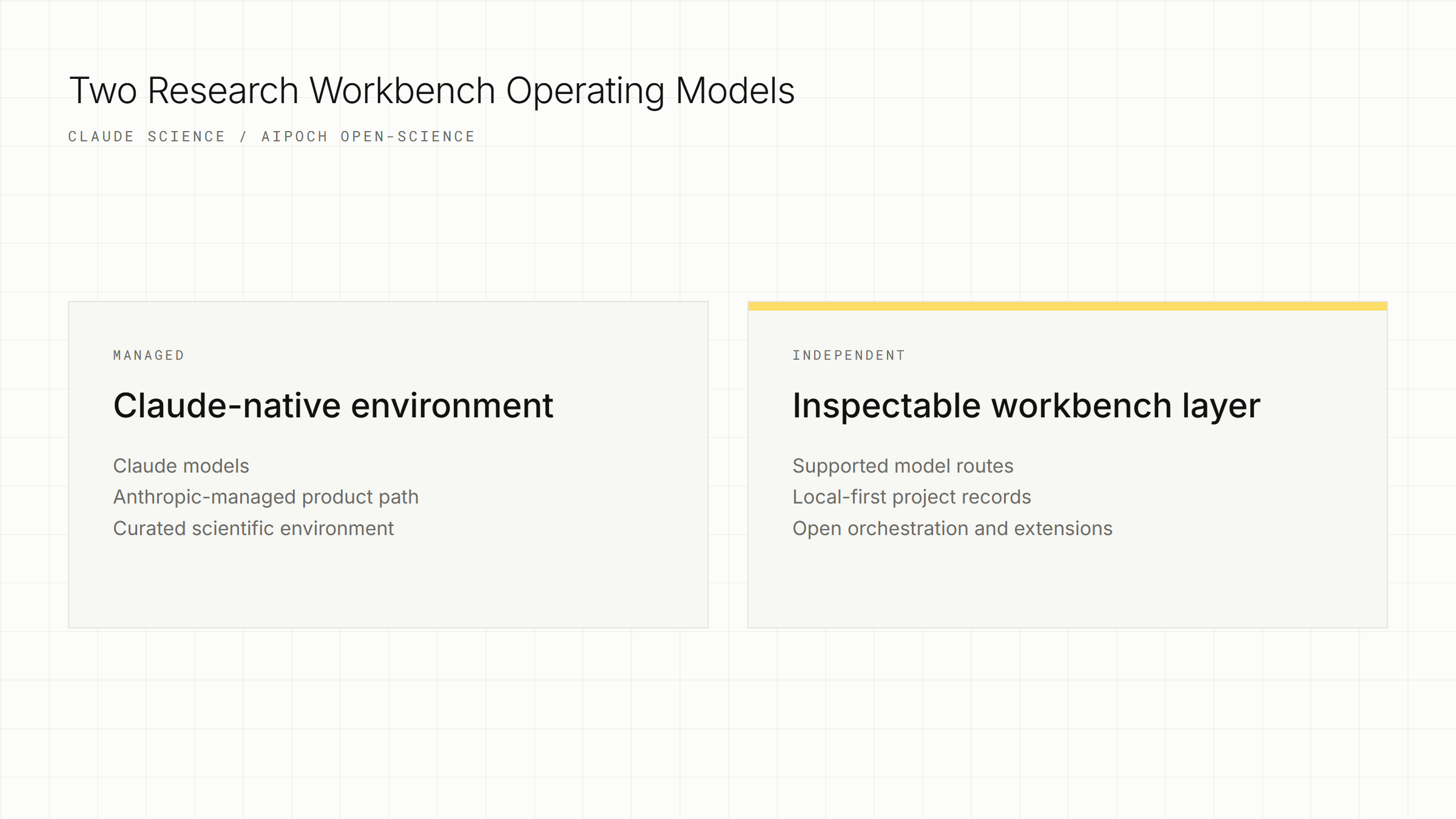
The durable difference is control placement: Claude Science centers Anthropic's managed Claude environment, while AIPOCH Open-Science exposes an independent workbench and inspectable orchestration layer.
The following graphic is a conceptual comparison for reference only.
| Decision area | Claude Science | AIPOCH Open-Science |
|---|---|---|
| Product model | Managed scientific application centered on Claude | Independent, Apache-licensed research workbench |
| Model strategy | Uses the Claude models available through the supported product offering | Separates the workspace from one provider and supports documented model routes |
| Workspace control | Anthropic manages the product environment and curated experience | Teams can inspect, modify, run, and extend the workbench source |
| Execution | Connects Claude-centered workflows with supported local and remote compute | Coordinates local Python/R/command execution and configured remote compute |
| Artifacts | Preserves documented code, environment, and conversation context with research outputs | Stores immutable artifact versions with available production and lineage evidence |
| Extensibility | Uses Anthropic-supported skills, Connectors, specialists, and existing lab tools | Supports inspectable Skills, Connectors, Specialists, packages, and custom MCP connections |
| Data boundary | Raw data and compute may remain on chosen infrastructure while selected content is processed by Claude | Project state remains local by default; approved providers and services receive required context |
| Operating responsibility | Anthropic manages more of the application and model path | The team assumes more responsibility for configuration, updates, permissions, and governance |
The table does not score implementation quality or scientific accuracy. Similar terms such as “artifact,” “skill,” “Connector,” or “reviewer” do not establish identical scope or behavior across products.
Why Does Open-Source Governance Matter in a Claude Science Alternative?
Open-source governance matters when a team needs to inspect or change the workbench layer rather than only use the capabilities exposed by a managed product.
With AIPOCH Open-Science, teams can inspect the application code, orchestration paths, Skill packages, Connector definitions, tool activity, and generated files. A laboratory can review the workbench, fork it, add internal methods, or package approved workflows for reuse.
Source access does not make every model, data service, or compute environment open. External providers retain their own terms and access rules. The open-source boundary applies to the Open-Science workbench and its published components, not every dependency.
The tradeoff is operational responsibility. A team choosing an inspectable workbench must review updates, manage credentials, approve Connectors, maintain environments, and support users. A managed product may reduce some of that burden while giving the vendor more control.
How Does AIPOCH Open-Science Support a Reviewable Research Workflow?
AIPOCH Open-Science supports review by connecting explicit inputs and criteria to permissioned execution, versioned outputs, and available provenance evidence.
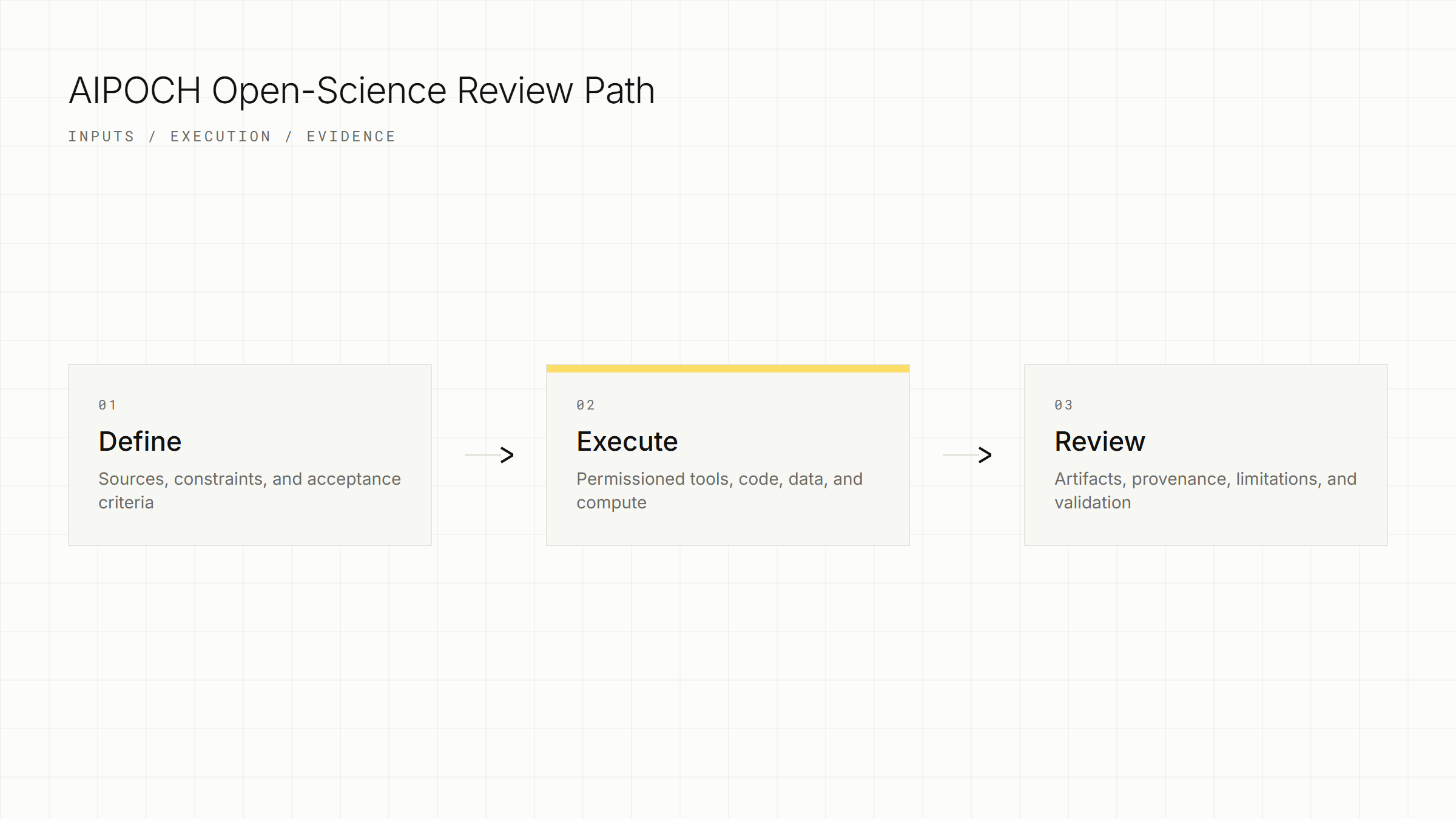
- Define the project and acceptance criteria. Record the question, source material, method constraints, expected files, and checks that should be performed.
- Choose the model and execution boundary. Select a supported model route, local or remote runtime, and the narrowest permission profile that fits the task.
- Execute with visible tool activity. Let the agent assist with approved searches, file operations, code, Notebooks, Connectors, or remote compute while retaining the activity record.
- Review the artifacts. Inspect reports, tables, figures, code, and available provenance evidence. Treat analytical output as a starting point for researcher review.
- Correct, continue, or branch. Record limitations, revise the method, continue in the project, or create a separate branch when an alternative approach should remain independently inspectable.
This workflow keeps review close to execution, but it does not guarantee deterministic replay or scientific validity. Reproduction still depends on data, environments, random behavior, external services, assumptions, and captured evidence.
For a domain-focused discussion, see AIPOCH's guide to the AI bioinformatics workflow requirements researchers should evaluate. For an evidence-led example of why matched outputs and divergences both matter, see the Claude Science bioinformatics reproduction review.
Can a Team Use Claude Through AIPOCH Open-Science?
A team can use a supported Claude connection through Open-Science while retaining the AIPOCH workbench as the project, execution, and artifact layer. The exact route depends on the installed application, agent backend, account, and protocol.
The decision is therefore not always “Claude or Open-Science.” A laboratory may use Claude at the model layer while keeping Open-Science projects, permissions, research resources, execution records, artifacts, and researcher review as separate workbench layers. Confirm the intended route in the provider settings and run the connection test before relying on it.
What Data Can Leave Each Workbench?
Local execution and local storage do not mean that every configured workflow is offline. Teams should map each external call before placing sensitive or unpublished material into either product.
Anthropic states on the Claude Science product page that raw datasets and compute can remain on the user's infrastructure, while content included in prompts and model responses is processed by Anthropic under the applicable terms.
The AIPOCH Open-Science repository states that project data, application state, artifacts, provenance evidence, credentials, and logs are stored locally. External data flow can still occur when a researcher approves a model request, web search, remote Connector, or remote-compute action.
Before adoption, document which files and prompt context may reach a model provider, which parameters are sent to connected services, what reaches remote compute, where credentials are stored, which actions require approval, and whether outputs contain confidential material.
Do not publish API keys, access tokens, patient identifiers, confidential research data, or sensitive local paths in prompts, screenshots, reports, or public issue logs.
Which Workbench Operating Model Fits Your Team?
Choose the operating model that matches the team's governance, model strategy, compute, evidence, and maintenance requirements. A product-level decision should follow those requirements rather than a feature-count comparison.
Claude Science may fit when
- the team wants a scientific workbench centered on Claude;
- Anthropic's managed product path and curated scientific environment match procurement and governance needs;
- the team prefers the vendor to manage more of the application and model experience;
- the required research tools and compute connections are supported by the maintained Claude Science offering.
AIPOCH Open-Science may fit when
- source access and orchestration inspection are selection requirements;
- the team wants to evaluate supported models without replacing the project workspace;
- local-first project records and explicit external-call boundaries matter;
- Python, R, command, Notebook, SSH, or scheduler-based research execution must remain associated with project artifacts;
- reusable Skills, custom Connectors, Specialists, or internal methods need to be inspectable and portable;
- the team accepts responsibility for configuring and governing an independent workbench.
Use this adoption checklist
- Which code and configuration must the institution be able to inspect?
- Is the organization committed to Claude, or does it require model choice?
- Where may data, prompt context, code, and outputs be processed?
- Which local, remote, and scheduler-based compute paths are required?
- What evidence must accompany each research artifact?
- Who owns approvals, environment maintenance, updates, and scientific validation?
Conclusion
Claude Science and AIPOCH Open-Science address a similar workflow problem through different control models. Claude Science integrates scientific work around Claude and Anthropic's maintained environment. Open-Science provides an independent, open-source workbench for teams that want supported model choice, local project records, permissioned execution, extensible research resources, and provenance-linked artifacts.
The strongest reason to consider Open-Science is not a temporary difference in catalog size or release timing. It is the persistent architectural choice to keep the research workspace inspectable and separable from one model provider.
Explore the AIPOCH Open-Science product page, inspect the maintained Open-Science repository, and compare those materials with the current Claude Science product page. A research team should test its own representative workflow, data boundary, and review requirements before adoption.
Frequently Asked Questions
Is AIPOCH Open-Science an open-source Claude Science alternative?
Yes, for teams seeking an independent, open-source AI research workbench in the same broad category. Open-Science is not a copy of Claude Science and does not claim identical integrations, behavior, or scientific performance.
Is Claude Science a model?
No. Claude Science is an application that uses Claude models and adds scientific tools, compute connections, persistent work, artifacts, and review features around them.
Is Claude Science open source?
Anthropic presents Claude Science as a managed beta application, while AIPOCH Open-Science publishes its workbench source under the Apache License 2.0. Teams with a formal source-access requirement should verify the license and source materials available from each vendor at the time of evaluation.
Can AIPOCH Open-Science use Claude?
Yes, when a supported Claude connection is available for the selected agent backend, account, and protocol. Confirm the exact route with the provider settings and connection test in the installed application.
Does AIPOCH Open-Science guarantee reproducible research results?
No. Open-Science preserves artifact versions and available provenance evidence to support inspection and reproducible execution. Researchers must still verify data, methods, code, environments, statistical assumptions, and conclusions independently.
Disclaimer
This article is intended for informational purposes only and does not constitute medical advice, clinical guidance, diagnostic recommendations, treatment decisions, or validated scientific conclusions. The comparison graphics are conceptual and do not represent validated research findings or real-world results.
AIPOCH Open-Science is a research workflow tool. It does not replace researcher judgment, and researchers remain fully responsible for evaluating the accuracy, completeness, and appropriateness of any outputs generated. All outputs require independent verification and expert interpretation before use in any research context.
References and external links in this article are provided for informational purposes. AIPOCH does not endorse and is not responsible for the content of third-party sources. Open-Science is not affiliated with or endorsed by Anthropic; Claude and Claude Science are products of Anthropic.