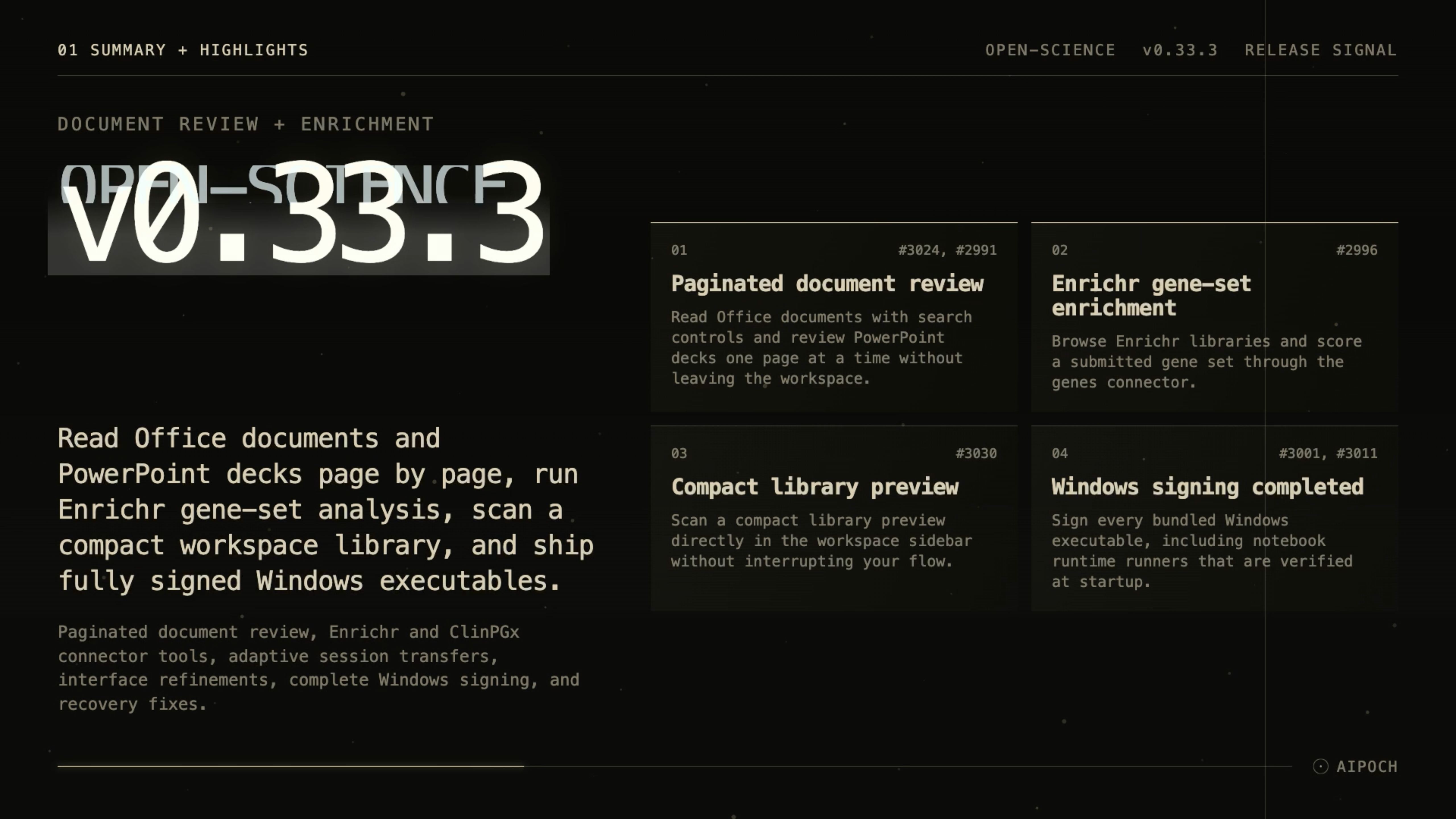
AIPOCH Open-Science v0.33.3 helps researchers review long Office files and PowerPoint decks, explore gene-set enrichment, scan their library, and install signed Windows executables.
[AIPOCH Open-Science](GitHub - aipoch/open-science: The open-source AI research workbench for scientific research and agen) is an open-source, local-first, model-agnostic AI research workbench developed by AIPOCH for inspectable research workflows.
The official v0.33.3 release was published on September 26, 2026; this article summarizes implemented capabilities from the release notes and does not extend them into roadmap claims.
What new capabilities help researchers review v0.33.3?
Version 0.33.3 adds focused tools for reading long documents, reviewing presentations, interpreting submitted gene sets, and scanning literature records. The [official v0.33.3 release](Release AIPOCH Open-Science v0.33.3 · aipoch/open-science) is the source for the implemented capabilities described below.
Paginated Office document review
Long office documents are easier to inspect when the reader can move through pages and search without leaving the research workspace. Open-Science preview now provides paginated Office reading with search controls, so a researcher can locate a passage, move through the surrounding pages, and keep the document alongside the active project context. The feature supports review of the file's content; it does not turn a preview into a validation of the document's claims.
Paged PowerPoint review
Presentation decks often carry evidence in a sequence of slides rather than a single continuous page. Version 0.33.3 lets researchers step through PowerPoint slides page by page with reading controls inside the preview panel. This keeps slide order and nearby context visible while a researcher checks a deck or prepares a follow-up analysis.
Enrichr gene-set enrichment
Gene lists need a reference library and a stated comparison context before enrichment results can be interpreted. The genes connector now lets researchers browse Enrichr libraries and submit a gene set for enrichment scoring. The returned terms and scores can help organize follow-up questions for researcher review; they do not prove a biological mechanism or replace choices about the study design, background set, or statistical interpretation.
Compact library preview
Researchers often need a quick view of saved literature records before opening a full library panel. The workspace sidebar now includes a compact library preview for at-a-glance browsing. It supports navigation and triage while keeping the current workspace visible, so a researcher can decide which record or collection needs a closer inspection.
ClinPGx queries for pharmacogenomics research
Pharmacogenomics projects may require structured access to gene, variant, drug, and evidence information. The clinical-genomics connector now supports ClinPGx queries for drug–gene–variant annotations, dosing guidelines, regulatory labels, variant frequencies, and evidence levels. These are research data to inspect and contextualize; they are not patient-specific recommendations, prescribing instructions, or a substitute for clinical or scientific judgment.
What else is new in v0.33.3?
The release also improves session transfer, literature review state, and interface feedback. These changes make routine work easier to follow while preserving the boundaries of the underlying records.
- Smart Literature collections now include an abandoned-evaluation action for references that no longer need screening.
- Session-package exports and imports gain adaptive transfer speed options, while long background transfers use a minimized progress presentation.
- Interface-scale shortcuts use one consistent scheme across the application.
- Hover hints and bubble motion share a unified interaction pattern, message arrivals animate in the message center, and message navigation gains a denser continuous hover wave.
These changes affect navigation and workflow control. They do not change the requirement to review source records, connector responses, and generated outputs before using them in research.
Bug fixes that affect daily use
The [release notes](Release AIPOCH Open-Science v0.33.3 · aipoch/open-science) group the fixes across preview, notebooks, sessions, connectors, literature, skills, and session packages:
- Preview and interface: the PDF reading tab now matches the file header's font size; collapsed sidebar icons can show tooltips; row hit targets align with hover surfaces; and warm hover switches can skip unnecessary bubble entry motion.
- Notebook recovery: kernel recovery fences are isolated by lane, so recovery in one kernel does not block another.
- Session continuity: conversation saves defer while runs are active; failed retries remain recoverable and dismissible; run-error notices can be dismissed; and archive recovery is scoped to affected projects. Renamed diagnostic exports also receive an archive suffix.
- Connectors and literature: native file access honors granted folders; Crossref abstracts can be imported during metadata completion; and classification selects the first model consistently for both supported features.
- Skills and session packages: skill metadata and managed Python runtimes are handled correctly; numeric cache usage is accepted in session-package exports; and numeric token metrics remain intact during export.
The fixes improve recoverability and record handling. They do not certify the correctness of a connector response, an imported abstract, or a scientific conclusion.
Install or update
Install or update AIPOCH Open-Science v0.33.3 from the [official release page](Release AIPOCH Open-Science v0.33.3 · aipoch/open-science). The release supports macOS 12 or later on Apple Silicon or Intel, Linux x64, and Windows 10/11 x64.
The official Windows package is code-signed, including bundled executable files and notebook runtime runners verified at startup. Official macOS builds are Developer ID signed and notarized by Apple. Verify that the installer came from the official release before opening it, especially when downloading a package from a mirror or a locally assembled build.
Existing installations can update in place. After updating, a useful first check is to open a long Office document or slide deck, search within the paginated preview, and inspect the surrounding pages before continuing the research task.
Resources
- [AIPOCH Open-Science v0.33.3 release and downloads](Release AIPOCH Open-Science v0.33.3 · aipoch/open-science)
- AIPOCH Open-Science product overview
- AIPOCH
- AIPOCH Open-Science v0.31.1: More Genomics Tools, Optional Classification Models
- AIPOCH Open-Science v0.31.0: Fork Research Sessions
- AIPOCH Open-Science .science: Research Handoff Guide
FAQ
What are the main features in AIPOCH Open-Science v0.33.3?
The release adds paginated Office reading with search controls, paged PowerPoint review, Enrichr gene-set enrichment, a compact library preview, and ClinPGx queries in the clinical-genomics connector. It also adds abandoned-evaluation handling, adaptive session-package transfers, and complete Windows code signing.
Can v0.33.3 review Office documents and PowerPoint decks page by page?
Yes. Office documents can be read with pagination and search controls, while PowerPoint decks can be reviewed one slide at a time inside the preview panel. The preview helps researchers inspect document context; it does not validate the underlying claims.
Does the Enrichr or ClinPGx integration provide clinical advice?
No. Enrichr results and ClinPGx records are research outputs for researcher review. They do not provide patient-specific recommendations, prescribing instructions, or validated clinical conclusions.
Which platforms support v0.33.3?
Version 0.33.3 supports macOS 12 or later on Apple Silicon or Intel, Linux x64, and Windows 10/11 x64. The official Windows package is code-signed, and official macOS builds are signed and notarized.
What should I check after updating?
Start with a document or deck that you already understand. Search it in the paginated preview, inspect nearby pages or slides, and then review any enrichment or connector output against the source data and research assumptions.
Disclaimer
This article is for informational purposes only. AIPOCH Open-Science supports research workflows and does not replace scientific judgment, peer review, domain-specific validation, clinical expertise, or institutional data-governance requirements. The document previews, enrichment results, pharmacogenomics records, and other outputs described here require independent review before use in any research context.
AIPOCH Open-Science does not provide medical advice, diagnosis, treatment decisions, or patient-specific prescribing recommendations. Researchers remain responsible for checking source data, methods, statistical assumptions, permissions, and the appropriateness of any interpretation.
References and external links are provided for information. AIPOCH does not endorse and is not responsible for the content of third-party sources.