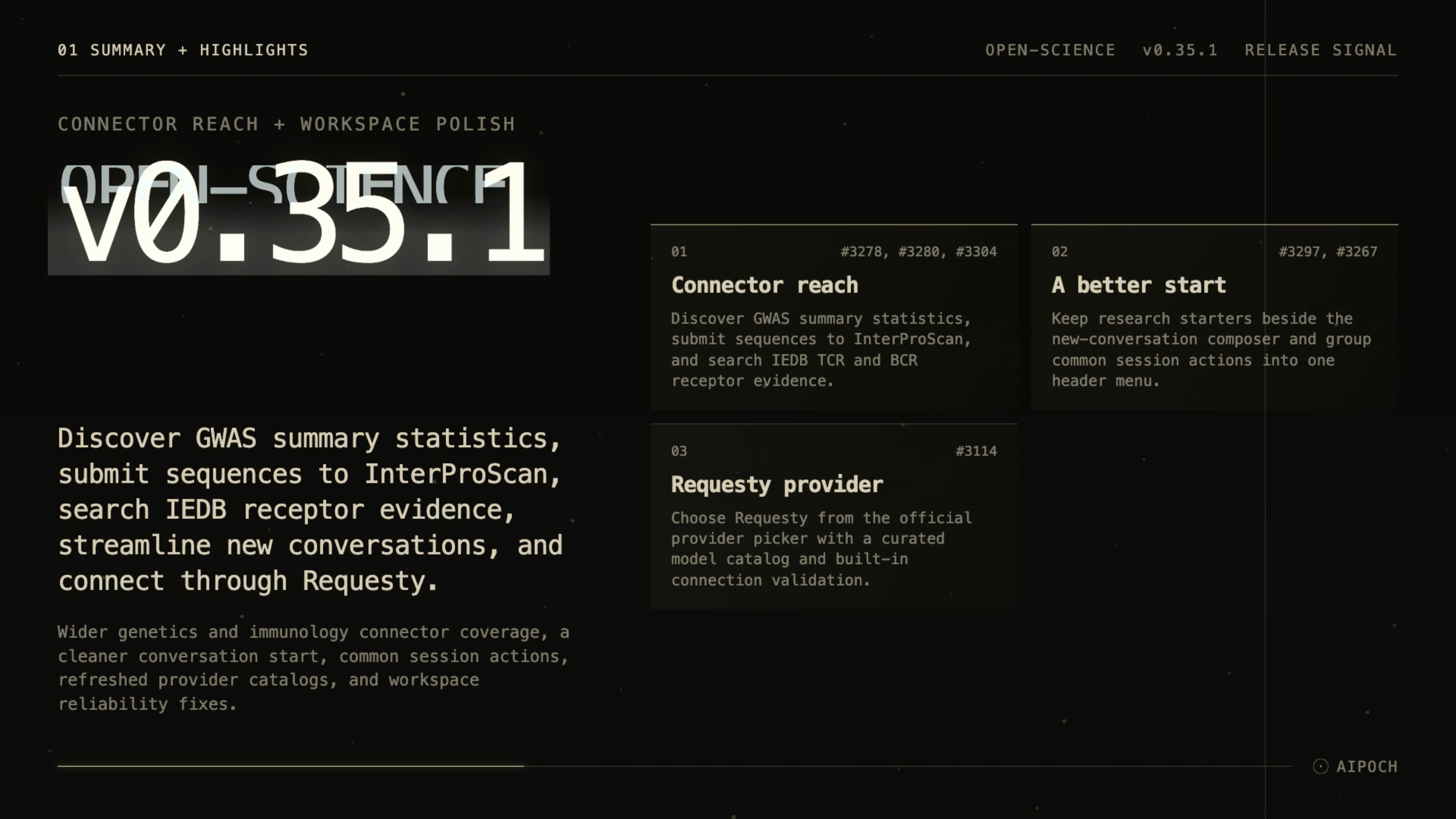
AIPOCH Open-Science v0.35.1 adds three research connectors, a clearer session workspace, and a new Requesty provider for model access.
AIPOCH Open-Science is an open-source, local-first, model-agnostic AI research workbench developed by AIPOCH for inspectable scientific workflows. The release also keeps .science research packages available for selected conversation branches, file versions, Notebook records, and verification evidence that researchers can review, hand off, and archive across projects or computers.
What new capabilities help researchers reach research evidence in v0.35.1?
Published on October 6, 2026, AIPOCH Open-Science v0.35.1 expands the connector catalog and keeps returned records available for researcher review. Each connector depends on upstream coverage, access status, query parameters, and service limits.
GWAS summary statistics discovery
Researchers can use the human genetics connector to locate complete summary-statistics files, study metadata, and reference genome information. The workflow is available from Session → Connector / Workspace → GWAS Summary Statistics Discovery, where a researcher can enter search conditions or select a resource.
The connector can return source, status, or download information alongside the result. That context helps researchers compare candidate files and decide which original records and methods require closer inspection.
InterProScan sequence submission
InterProScan now supports bounded sequence submission with status tracking and result retrieval. The Session → Connector / Workspace → InterProScan Sequence Submission entry lets a researcher submit a sequence task, follow its state, and read the returned result in the same research context.
This creates a submit → status → results path for supported sequence jobs. The returned annotation evidence remains an input for researcher review, and availability depends on the upstream service and the submitted parameters.
IEDB receptor evidence search
The IEDB connector adds searches for T-cell receptor (TCR) and B-cell receptor (BCR) evidence alongside its existing epitope and assay search. Researchers can open Session → Connector / Workspace → IEDB Receptor Evidence Search and inspect structured results with source and status context.
This helps a literature or evidence workflow keep receptor searches near the project record. It does not replace checking the underlying record, assay context, or method before using a result in research.
What else is new in v0.35.1?
Version 0.35.1 makes the starting and session surfaces easier to scan while adding a provider option.
- New conversation start experience: research starters stay one click away while the researcher drafts, and the screen includes a compact package import option.
- Common-actions session menu: the session header groups edit, pin, side chat, fork, export, and archive actions in one menu. Export options include the conversation, session package, and diagnostics.
- Requesty provider: Requesty is available in the official provider picker with a curated model catalog and built-in connection validation. Actual model availability depends on the selected framework, endpoint compatibility, account, region, and installed version.
- Workspace polish: side chat tabs and the toolbar follow the compact workspace layout, and the OpenRouter and Requesty catalogs are refreshed.
A .science package remains a bounded research handoff format. Imported sessions are read-only and do not execute code or restore credentials; a received verification record describes checks performed on the sending installation rather than proving that the receiving computer reran them. Side Chat conversations and private reading bookmarks are excluded, and included files depend on the export selection. Researchers can fork an imported session into a writable continuation when the supported workflow allows it.
Bug fixes that affect daily use
Version 0.35.1 includes fixes across sessions, notebooks, PDF work, permissions, and workspace controls.
- Replay and sessions: replay preserves follow-up scrolling and recorded file questions; imported sessions keep historical interactions read-only; and the composer retains its context when session binding changes.
- Notebook and runtimes: cross-language notebook file lineage is projected correctly, corrupt run documents are isolated without blocking recovery, and R environments are preserved when project paths contain spaces.
- PDF and preview: literature layout extraction is hardened for complex external papers, PDF context persists before the first prompt, verified PDF notes are unified across projects, and persistent reader notices are reduced.
- Agents and permissions: shared-login settings are isolated by default, and unattended Claude permission denials are explained in the workspace.
- Workspace reliability: titlebar layering, side chat alignment, session header icons, bookmarks, preview highlights, expired artifact transactions, credential false positives, and bookmark failure diagnostics receive targeted fixes.
Install or update
AIPOCH Open-Science v0.35.1 supports macOS 12 or later on Apple Silicon or Intel, Linux x64 or ARM64, and Windows 10/11 x64. Download the package for your platform from the official v0.35.1 release, or build from source with the repository instructions.
Official macOS builds are Developer ID signed and notarized, and official Windows builds are code-signed. On first run, the onboarding wizard checks the environment and can install and configure an app-managed agent runtime. Existing installations can update in place.
Resources
- AIPOCH Open-Science v0.35.1 release notes and downloads
- AIPOCH Open-Science product overview
- AIPOCH Open-Science v0.34.0: Reach More Research Data
- AIPOCH Open-Science .science: Share Research with Context
FAQ
What does AIPOCH Open-Science v0.35.1 add?
It adds GWAS summary statistics discovery, InterProScan sequence submission, IEDB TCR and BCR receptor evidence searches, a refreshed conversation start experience, a common-actions session menu, and the Requesty provider.
Which platforms support AIPOCH Open-Science v0.35.1?
The release supports macOS 12 or later on Apple Silicon or Intel, Linux x64 or ARM64, and Windows 10/11 x64. Provider, connector, and runtime availability still depends on the local installation and enabled services.
Can imported .science sessions run code?
No. Imported .science sessions are read-only. Researchers can inspect the imported record and, where supported, fork it into a writable continuation, but import does not execute code or restore credentials.
Does v0.35.1 prove that a research result is reproducible?
No. Replay reproduces recorded steps rather than rerunning them, and solver-exact equivalence remains open. Verification records describe the checks captured by the source installation, so researchers must perform any new execution and scientific assessment needed for their work.
Does Requesty provide every model through one gateway?
No. Requesty is available in the official provider picker with a curated catalog and connection validation, while the available endpoint and model set depend on the active framework, account, region, protocol, and installed version.
Disclaimer
AIPOCH Open-Science assists researchers with research workflows but does not replace scientific judgment or peer review. Connector results, model outputs, literature records, execution traces, and verification evidence require independent review of source data, methods, assumptions, and context before use in research.