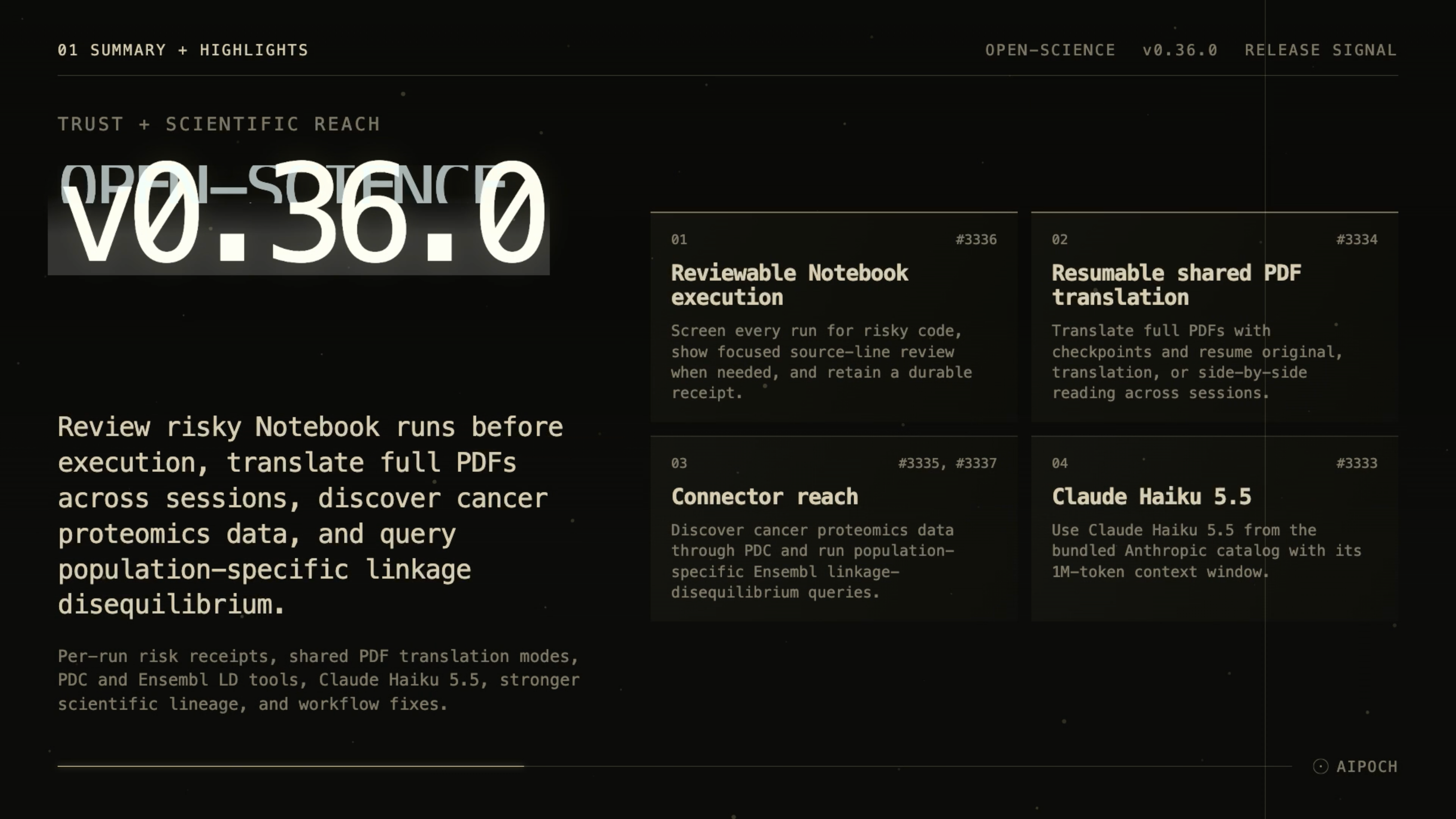
AIPOCH Open-Science v0.36.0 makes Notebook runs reviewable, PDF translation resumable, and scientific data access broader for day-to-day research.
AIPOCH Open-Science is an open-source, local-first, model-agnostic, self-hosted AI research workbench for reproducible scientific discovery, developed by AIPOCH for inspectable scientific workflows. The release also keeps .science research packages available for selected conversation branches, file versions, Notebook records, and verification evidence that researchers can review, hand off, and archive across projects or computers.
What new capabilities help researchers review work and reach evidence in v0.36.0?
Published on October 8, 2026, AIPOCH Open-Science v0.36.0 focuses on reviewable execution, long-document reading, and wider scientific connector access. The capabilities below are implemented in the released build; results still depend on permissions, upstream coverage, selected parameters, and the local environment.
Reviewable Notebook execution
Notebook runs in v0.36.0 are screened for destructive or risky code before dispatch. Ordinary reads and analysis can proceed without repeated prompts, while a risky run surfaces a focused review card with source-line context. After the run is reviewed, Open-Science retains a durable receipt so the researcher can inspect what was screened and what decision was recorded.
This gives a Notebook workflow a review point close to execution. The receipt is inspectable provenance evidence for the recorded run; it does not certify that the code is scientifically appropriate or replace review of methods, inputs, and outputs.
Resumable shared PDF translation
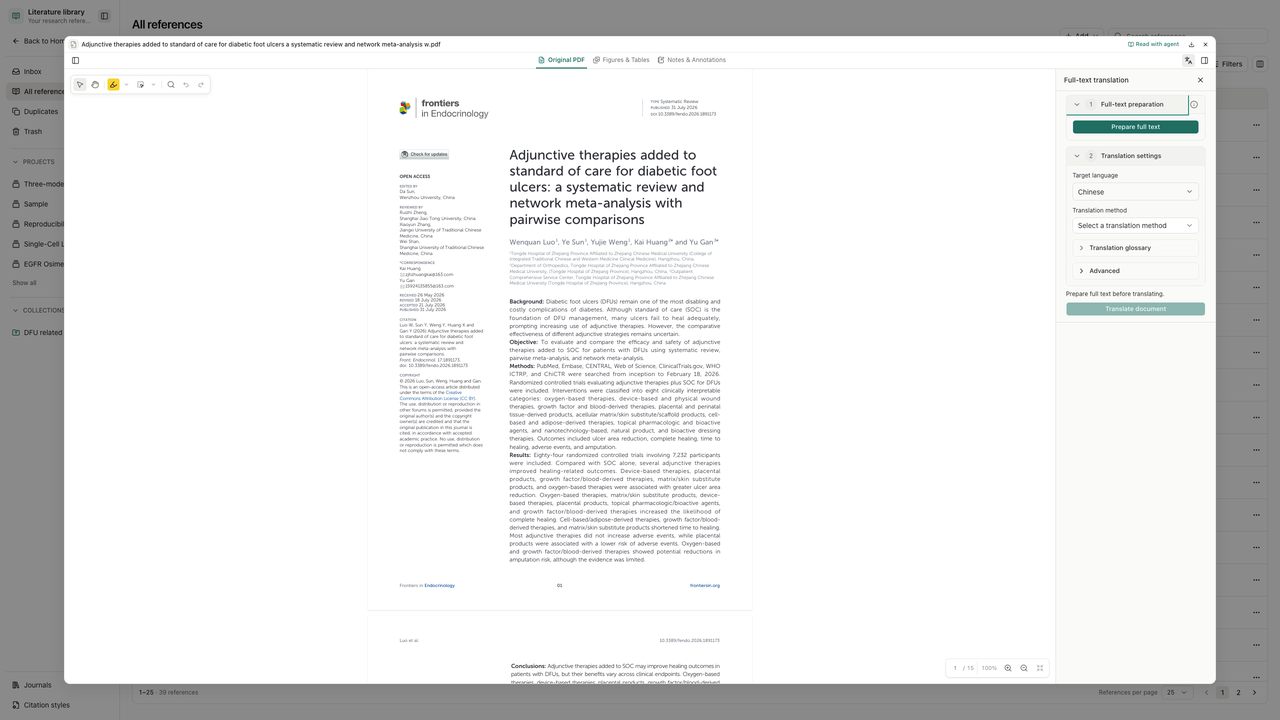
A managed PDF can now be translated as a full document with paragraph-level checkpoints. Researchers can switch between the original, the translation, and a side-by-side comparison, then resume the translation across sessions. One saved edition is shared across Literature Library, Reading, Inbox, and Workspace entries for that managed PDF.
The shared edition keeps reading work in the project context instead of creating disconnected copies for each entry. Translation quality, source layout, and the usefulness of a particular passage still require researcher review against the original document.
Screenshot: actual AIPOCH Open-Science product view from a real session; shown for researcher review.
PDC cancer proteomics discovery
The new PDC connector lets researchers search the Proteomic Data Commons for cancer proteomics studies, biospecimen associations, and quantitative file metadata. Returned records give a starting point for comparing candidate studies and locating the source files or metadata that a project needs to inspect.
PDC coverage and availability come from the upstream service. A connector result is an evidence input for researcher review, not an interpretation of a study or a conclusion about a biological question.
Population-specific Ensembl linkage-disequilibrium queries
The Genomes connector adds population-specific Ensembl linkage-disequilibrium endpoints. Researchers can request pairwise r² or D′ values and look up proxy variants for a selected population, which supports comparison of association signals within a documented query context.
The returned association measures depend on the population, variant identifiers, reference data, and query parameters. Researchers should retain the query context and inspect the underlying records before using a result in an analysis.
What else is new in v0.36.0?
Version 0.36.0 also adds a model option, batch-selection controls, and clearer artifact mentions.
- Claude Haiku 5.5: The bundled Anthropic catalog now includes Claude Haiku 5.5 with its stated 1M-token context window. Actual access depends on the selected framework, account, endpoint, region, and installed version.
- Batch selection: Literature Library and Inbox toolbars can select all items on the loaded page, which helps researchers prepare a bounded batch for review.
- Project-file mentions: A project file card or the open artifact can be dragged into the composer to add a file mention to a conversation.
- Scientific dependency lineage: Python and R notebooks track more scientific readers, container transforms, and callbacks, so dependency edges and file effects remain more visible in the project record.
.scienceboundaries remain explicit: A package can carry selected conversation branches, file versions, Notebook records, and verification evidence. Imported sessions are read-only and do not execute code or restore credentials; Side Chat conversations and private reading bookmarks are excluded; included files depend on export selection; and a received verification record describes checks performed by the sending installation rather than proving that the receiving computer reran them.
Bug fixes that affect daily use
Version 0.36.0 includes fixes across PDF handling, files, search, marketplace access, model selection, and composer controls.
- PDF structure extraction: Native scientific layouts are preserved more faithfully, including complete tables, tiered headers, footers, and multi-panel figures.
- Files and search: The Files panel no longer blocks file mentions in a new conversation, and Find (Ctrl/Cmd+F) works again in an empty workspace.
- Marketplace and composer: Specialist Marketplace opens in Remote Web, and compact mention chips in new-session composers return to their normal size.
- Model selection: Context-size suffix aliases are removed from official model catalogs, fixing selection failures with some engines.
Install or update
AIPOCH Open-Science v0.36.0 supports macOS 12 or later on Apple Silicon or Intel, Linux x64 or ARM64, and Windows 10/11 x64. Download the appropriate package from the official v0.36.0 release, or build from source with the Open-Science repository instructions.
Official macOS builds are Developer ID signed and notarized, and official Windows builds are code-signed. On first launch, the onboarding wizard checks the environment and can install and configure an app-managed agent runtime. Existing installations can update in place.
Resources
- AIPOCH Open-Science v0.36.0 release notes and downloads
- AIPOCH Open-Science product overview
- AIPOCH
- AIPOCH Open-Science .science: Share Research with Context
- AIPOCH Open-Science v0.34.0: Reach More Research Data
- Extract Figures and Tables with AIPOCH Open-Science
FAQ
What does AIPOCH Open-Science v0.36.0 add?
It adds reviewable Notebook execution, resumable shared full-document PDF translation, PDC cancer proteomics discovery, population-specific Ensembl linkage-disequilibrium queries, Claude Haiku 5.5, page-level batch selection, and project-file mentions. The same release also includes PDF, search, marketplace, model-catalog, and composer fixes.
How does reviewable Notebook execution work in v0.36.0?
Every Notebook run is screened before dispatch. Ordinary analysis runs without repeated prompts; a run considered risky presents source-line context for review and retains a durable receipt after the recorded decision. The receipt supports inspection of that run and does not replace scientific or code review.
Can PDF translation resume across sessions in v0.36.0?
Yes. Full-document translation stores paragraph-level checkpoints and can resume across sessions, with original, translated, and side-by-side reading modes. One saved edition is shared across Literature Library, Reading, Inbox, and Workspace entries for the managed PDF.
Does a .science import execute code on the receiving computer?
No. Imported .science sessions are read-only and do not execute code or restore credentials. A receiving verification record describes checks captured by the sending installation, so a new execution and scientific assessment are still separate steps.
Which platforms support AIPOCH Open-Science v0.36.0?
The release supports macOS 12 or later on Apple Silicon or Intel, Linux x64 or ARM64, and Windows 10/11 x64. Provider, connector, model, and runtime availability still depends on the local installation and enabled services.
Disclaimer
AIPOCH Open-Science assists researchers with research workflows but does not replace scientific judgment or peer review. Connector results, model outputs, literature translations, execution receipts, and verification evidence require independent review of source data, methods, assumptions, and context before use in research.