A sample can be 99% chemically pure and still be racemic, moderately enriched, or nearly enantiopure. Chemical purity measures how much of the entire sample is the target compound. Enantiomeric excess measures the imbalance between the two mirror-image forms within that target.
The distinction becomes easier to audit in the AIPOCH Open-Science case “99% Pure: Does Molecular Handedness Matter?” Its .science package preserves the question, calculation script, eight hand-checkable mixtures, a 1,001-point sweep, saved outputs, and verification evidence in one inspectable record.
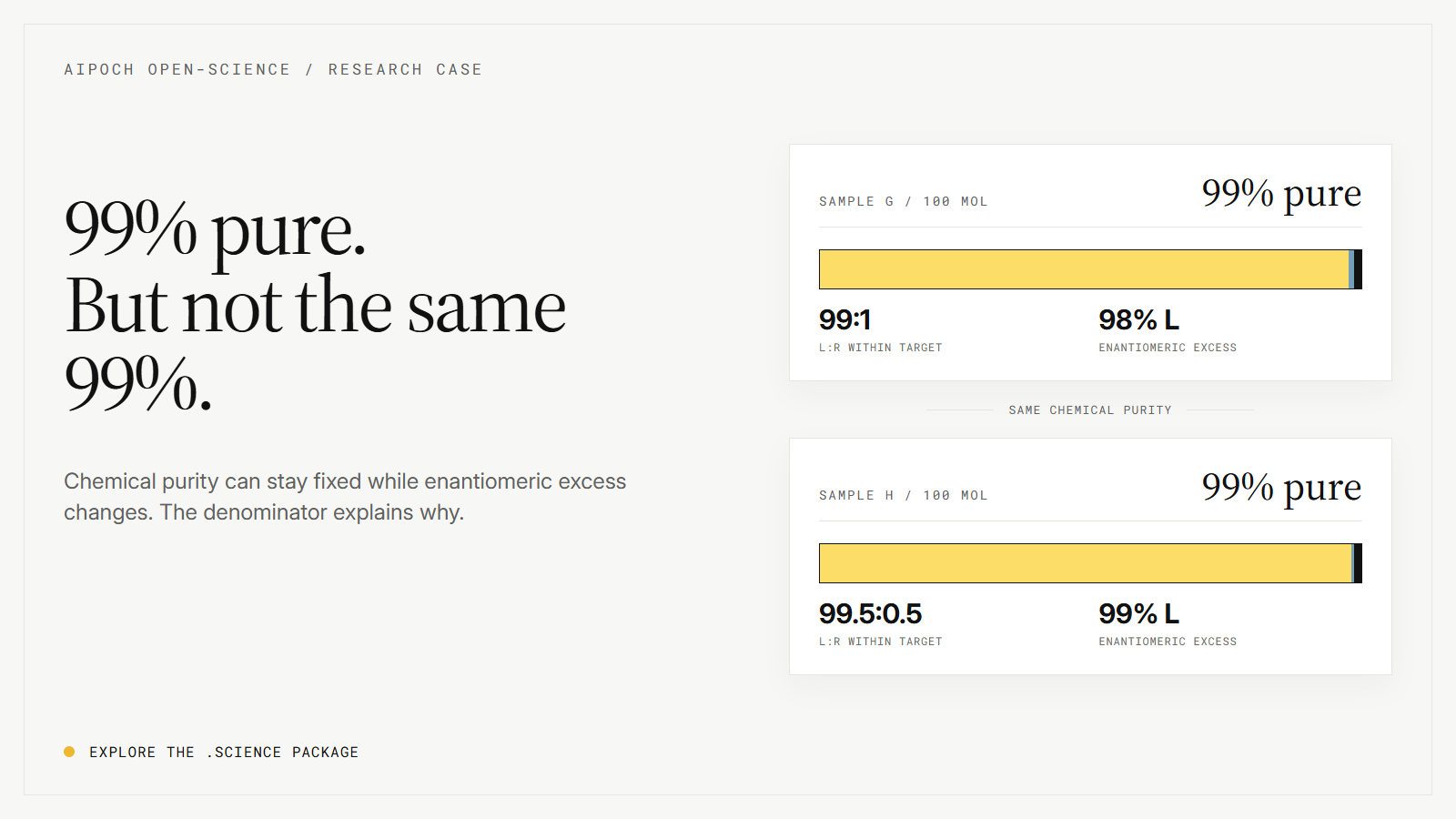
Conceptual cover using hypothetical values recorded in the case package. The two samples are not laboratory measurements.
Key takeaways
- Chemical purity and enantiomeric excess use different denominators.
- A 99:1 enantiomeric ratio equals 98% ee, while 99% ee equals a 99.5:0.5 ratio.
- A useful report names the target, amount basis, majority enantiomer, ratio, ee, analytical method, and uncertainty.
- The
.sciencepackage makes the recorded reasoning inspectable; importing it does not rerun the calculation or validate a laboratory result.
What is the difference between chemical purity and enantiomeric excess?
Chemical purity describes how much of the entire sample is the target compound, whereas enantiomeric excess describes how unevenly the two mirror-image forms divide only that target; the same sample can therefore score highly on one measure and anywhere from racemic to enantiopure on the other.
- The IUPAC Gold Book entry for enantiomeric excess, 5th edition (2025), defines ee from the difference between the two enantiomer fractions.
- The IUPAC Gold Book entry for enantiomeric ratio, 5th edition (2025), defines the ratio as the percentage of one enantiomer relative to the other.
- The AIPOCH Open-Science case page, verified in 2026, explicitly calculates chemical purity over the whole mixture but calculates ratio and ee over the target compound.
Use a 100-mole teaching mixture containing:
L: one enantiomer of the target compound;R: its mirror-image enantiomer; andI: an unrelated impurity.
The case uses L and R as teaching labels. They are not formal R/S configurations and do not state the sign of optical rotation.
Under the definition selected for this exercise, both enantiomers count as the target compound:
chemical purity = 100 × (L + R) / (L + R + I)
The enantiomeric ratio ignores the unrelated impurity:
enantiomeric ratio = L : R
Enantiomeric excess measures the imbalance between the two target populations:
ee = 100 × |L - R| / (L + R)
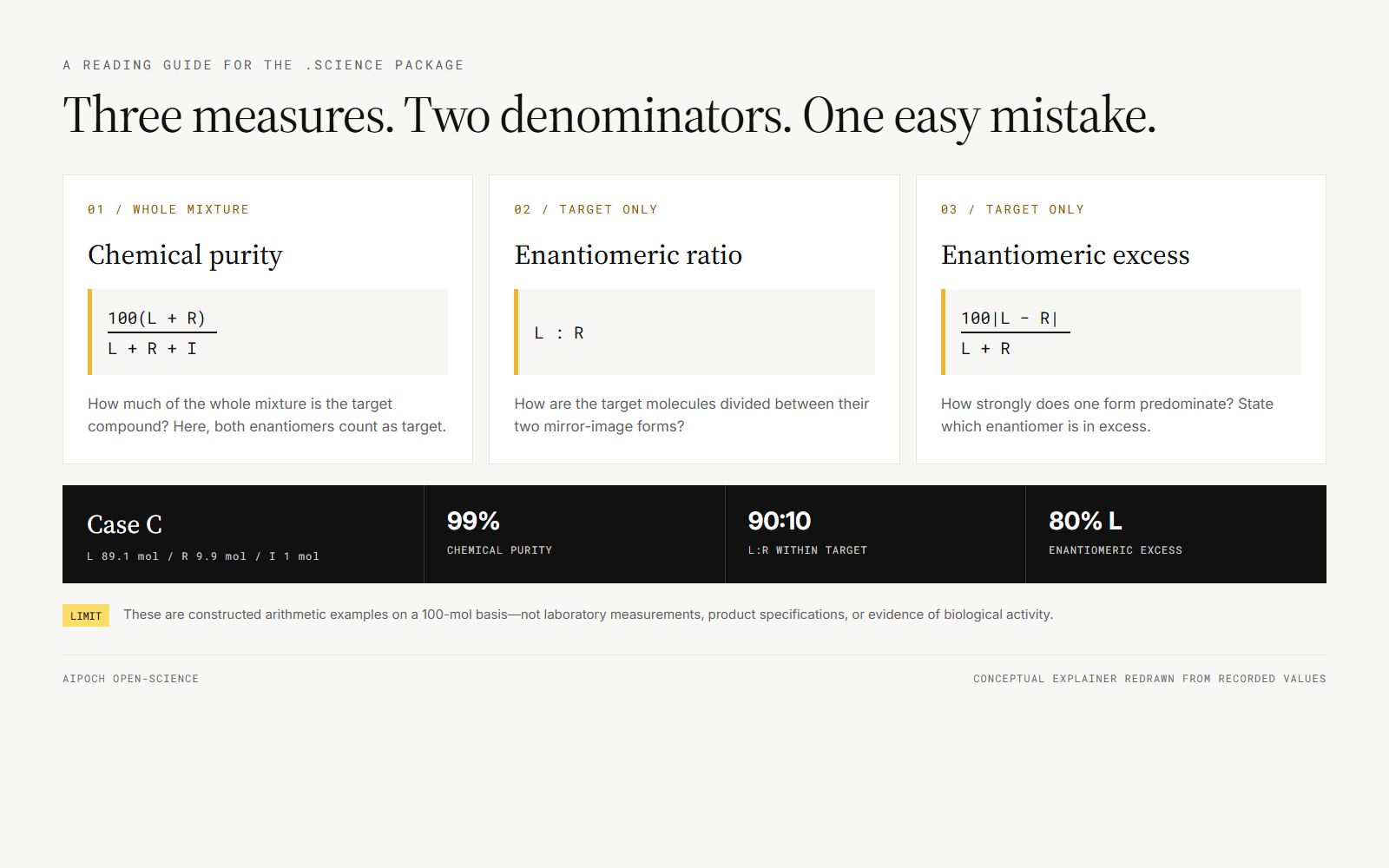
Conceptual explainer redrawn from the recorded formulas and Case C values. It is not an instrument readout or an experimental result.
Can two samples with 99% chemical purity have different enantiomeric excess?
Yes: when both enantiomers count as the target chemical, two samples can each be 99% chemically pure while one is a 50:50 racemate with 0% ee and another approaches a single-enantiomer composition with almost 100% ee, because chemical purity does not determine the internal L:R split.
- The AIPOCH case summary, verified in 2026, records eight hypothetical mixtures and a 1,001-point fixed-purity sweep.
- The linked AIPOCH
.sciencepackage, created in 2026, contains the saved CSV tables, Python calculation, report, figure, and execution evidence inspected for this article. - The FDA stereoisomeric-drug guidance (1992) treats stereoisomeric composition and ordinary identity, strength, quality, and purity controls as related but distinct reporting concerns.
The package’s hypothetical_mixtures.csv uses a common 100-mole basis:
| Mixture | L (mol) | R (mol) | Unrelated impurity (mol) | Chemical purity | L:R within target | Enantiomeric excess |
|---|---|---|---|---|---|---|
| A | 49.50 | 49.50 | 1.00 | 99% | 50:50 | 0% |
| B | 74.25 | 24.75 | 1.00 | 99% | 75:25 | 50% L |
| C | 89.10 | 9.90 | 1.00 | 99% | 90:10 | 80% L |
| D | 9.90 | 89.10 | 1.00 | 99% | 10:90 | 80% R |
| E | 99.00 | 0.00 | 1.00 | 99% | 100:0 | 100% L |
| F | 72.00 | 8.00 | 20.00 | 80% | 90:10 | 80% L |
| G | 98.01 | 0.99 | 1.00 | 99% | 99:1 | 98% L |
| H | 98.505 | 0.495 | 1.00 | 99% | 99.5:0.5 | 99% L |
Mixtures A through E each contain 99 moles of target and 1 mole of unrelated impurity. Their chemical purity is identical, but their ee values range from 0% to 100%.
Mixtures C and F expose the reverse case. Both have a 90:10 L:R ratio and 80% L ee, yet their chemical purities are 99% and 80%. Neither enantiomeric ratio nor ee reveals how much unrelated impurity is present.
How do you calculate enantiomeric excess from an enantiomeric ratio?
Calculate enantiomeric excess by subtracting the minor enantiomer fraction from the major fraction after normalizing the two enantiomers to 100%; for a major:minor ratio of a:b, the result is 100 × (a - b) / (a + b), with the majority enantiomer named separately.
- The IUPAC enantiomeric-excess definition (2025) uses the absolute difference between the two normalized enantiomer fractions.
- The IUPAC enantiomeric-ratio definition (2025) reports one enantiomer’s percentage relative to the other, so the two ratio terms must first share a common total.
- The AIPOCH case record, verified in 2026, gives both conversions: 99:1 corresponds to 98% ee, while 99% ee corresponds to 99.5:0.5.
For mixture C:
- target amount:
89.1 + 9.9 = 99 mol; - chemical purity:
100 × 99 / 100 = 99%; - normalized ratio:
89.1 : 9.9 = 90 : 10; and - ee:
100 × (89.1 - 9.9) / 99 = 80%, favoring L.
For a normalized ratio with major fraction M and minor fraction m:
ee (%) = M - m
For an ee value e, expressed as a percentage, the normalized composition is:
major (%) = (100 + e) / 2minor (%) = (100 - e) / 2
That is why 99:1 gives 99 - 1 = 98% ee, while 99% ee gives (100 + 99)/2 = 99.5% major and 0.5% minor. Unsigned ee does not identify which enantiomer is in excess, so the majority identity must accompany the number.
What does the 1,001-point fixed-purity sweep demonstrate?
The fixed-purity sweep demonstrates that chemical purity can remain exactly 99% while enantiomeric excess spans its full 0% to 100% magnitude range, so a single chemical-purity percentage cannot reconstruct enantiomeric ratio, majority identity, or the amount of either enantiomer within the target fraction.
- The AIPOCH case page, verified in 2026, reports a 1,001-point sweep with total chemical purity held constant.
- The downloadable 2026
.sciencepackage preservespurity_99_sweep.csv,enantiomer_calculations.py, and the saved plot used for the recorded result. - The IUPAC definition of enantiomeric excess (2025) explains why equal enantiomer fractions produce 0% ee and a single-enantiomer limit produces 100% ee.
The saved purity_99_sweep.csv varies the L fraction from 0% to 100% in 0.1-percentage-point increments while keeping L + R = 99 mol and I = 1 mol.
Across the 1,001 recorded grid points:
- chemical purity remains 99%;
- the L share of the target rises from 0% to 100%;
- the magnitude of ee falls from 100% to 0% at the racemic midpoint, then rises to 100%; and
- the L share of the whole mixture rises from 0% to 99%.
The V-shaped ee curve is not an experimental trend or an uncertainty estimate. It follows directly from the absolute-value definition and the constructed grid. The sweep does not estimate assay error, reaction selectivity, biological activity, or manufacturing quality.
Why must laboratory reports state the measurement basis?
A laboratory report should state the analyte definition, denominator, amount basis, analytical method, majority enantiomer, enantiomeric ratio, and ee rather than presenting one unlabeled purity percentage, because chemical purity and stereochemical composition answer different questions and may require different assays, controls, and uncertainty statements.
- The FDA guidance on stereoisomeric drugs (1992) calls for stereochemically specific identity or assay controls when dealing with enantiomeric and racemic drug substances.
- The IUPAC Gold Book (2025) allows ee fractions to be expressed on a mole or weight basis, making the selected amount basis part of the definition.
- The AIPOCH case, verified in 2026, shows that calling the opposite enantiomer part of the target or part of the impurity pool changes the meaning of “purity.”
Before interpreting a reported percentage, ask:
- What exactly counts as the target compound?
- Does the purity denominator include both enantiomers?
- Is the amount basis mole fraction, mass fraction, peak area, or another measurement?
- Which enantiomer is the majority, and how was its identity assigned?
- Is the result a ratio, composition percentage, ee, optical rotation ratio, or ordinary chemical purity?
- Which analytical method, calibration, response assumptions, detection limits, and uncertainty apply?
The IUPAC optical-purity entry (2025) defines optical purity from observed rotation relative to a pure enantiomer’s rotation. Optical purity and ee may coincide under suitable assumptions, but a report should not treat them as interchangeable without stating the method and conditions.
How can readers inspect the calculation in the AIPOCH Open-Science .science package?
Readers can inspect the AIPOCH Open-Science .science package by opening the archived report, matching each formula to the CSV columns and Python function, checking the saved figure and verification records, and then separating what the sender recorded from any new calculation that the receiving computer might perform.
- The public AIPOCH case page, verified in 2026, provides both the package download and the research-session view.
- The AIPOCH
.sciencepackage documentation, retrieved in 2026, states that imported sessions are read-only and that package contents depend on the sender’s export selection. - The AIPOCH reproducibility guide, updated in 2026, states that a sender-supplied verification record does not mean the receiving computer reran the check.
Start with these exact filenames:
| File | What to inspect |
|---|---|
enantiomer_report.md | Definitions, eight examples, sweep equations, qualifications, and the file list. |
hypothetical_mixtures.csv | Source amounts and calculated metrics for mixtures A through H. |
purity_99_sweep.csv | All 1,001 fixed-purity grid points, including ee_pct and signed_ee_L_pct. |
enantiomer_calculations.py | Recorded formulas, assertions, CSV exports, and plotting instructions. |
purity_and_enantiomers.png | Archived chart generated by the recorded Notebook run. |
A focused reading question is: Where does the unrelated impurity enter the denominator, and where is it deliberately excluded? Trace that choice from enantiomer_report.md into the CSV columns and then into the measures function in enantiomer_calculations.py.
The package inspected for this article was created on October 9, 2026. It contained six conversation messages, five managed artifacts, Notebook records, and associated execution evidence. Its SHA-256 was 32905d517617c013333224e29049e8b7e4212d2061070c37c38a336561af84e9 when checked on October 26, 2026.
What does the inspected package establish, and what remains unverified?
The inspected package establishes that the recorded examples, formulas, saved tables, file identities, and stated limitations are internally traceable, but it does not establish that the hypothetical mixtures were measured, that the archived Python ran on this computer, or that any laboratory method or scientific conclusion was independently validated.
- The downloaded 2026 research package contained 23 unique archive members, and every recorded manifest size and SHA-256 checked for this article matched the archived bytes.
- The official case summary, verified in 2026, labels the mixtures as constructed arithmetic examples rather than manufactured samples or biological evidence.
- The official package guide, retrieved in 2026, states that import does not rerun calculations, grant credentials, or replace artifact-version reproducibility checks.
The verification performed for this article was static. The archive structure, manifest checksums, exact filenames, saved tables, report, and code were inspected. The arithmetic used in the article was independently checked against the saved values, but the archived Python script was not executed and the scientific calculation was not rerun on this computer.
The package does not validate a laboratory assay, establish a drug specification, identify a biologically preferred enantiomer, or prove that an imported environment reproduced the computation. A new experiment should be recorded as a new computation, separate from the archived result.
What should you report instead of writing only “99% pure”?
Report chemical purity and stereochemical composition as separate, explicitly labeled results: define what counts as the target, identify the whole-sample and within-target denominators, name the majority enantiomer, provide the enantiomeric ratio and ee, and describe the method and uncertainty that produced each value.
- The IUPAC Gold Book definitions (2025) distinguish enantiomeric excess from the separate enantiomeric-ratio quantity.
- The FDA stereoisomeric-drug guidance (1992) explains why stereochemical composition can require stereochemically selective control rather than an achiral purity result alone.
- The AIPOCH recorded case, verified in 2026, demonstrates the reporting failure directly: identical chemical purity can coexist with any ee value represented by the constructed grid.
A compact result statement could read:
Chemical purity: 99.0% of the whole sample on a stated mole basis. Enantiomeric composition within the target: L:R = 90:10, corresponding to 80% ee favoring L. Method, calibration assumptions, detection limit, and uncertainty: reported separately.
That wording does not claim a result is accurate merely because the quantities are labeled. It makes the scientific question, denominator, and evidentiary burden visible.
To inspect the worked example, open the AIPOCH Open-Science case and its .science package, then follow one mixture from the report to the CSV and calculation script. For the broader handoff workflow, see the AIPOCH Open-Science .science package guide.
What other questions do readers ask about enantiomeric excess and chemical purity?
Readers most often need to distinguish a 99:1 ratio from 99% ee, determine whether high chemical purity can coexist with a racemate, understand whether optical purity is interchangeable with ee, and confirm whether the AIPOCH case represents measured samples or constructed arithmetic examples.
- The IUPAC definitions (2025) provide the formal basis for converting normalized composition into ee.
- The AIPOCH case page, verified in 2026, publishes the 99:1 versus 99% ee comparison and labels the examples as hypothetical.
- The AIPOCH package documentation, retrieved in 2026, distinguishes inspecting an imported record from creating a writable continuation and running a new calculation.
Is 99% ee the same as a 99:1 enantiomeric ratio?
No. For a two-enantiomer target, a 99:1 ratio corresponds to 98% ee. A 99% ee result corresponds to a 99.5:0.5 ratio, provided the majority enantiomer is identified.
Can a sample be 99% chemically pure and racemic?
Yes, under the case’s stated target definition. A hypothetical 100-mole mixture containing 49.5 moles of each enantiomer and 1 mole of unrelated impurity is 99% target compound but has 0% ee.
Is enantiomeric excess the same as optical purity?
Not automatically. IUPAC defines optical purity through observed rotation relative to a pure enantiomer, while ee is calculated from enantiomer fractions. A report should state the measurement method and conditions before treating the values as equivalent.
Did AIPOCH Open-Science experimentally measure these samples?
No. The .science package records constructed arithmetic examples and a deterministic sweep. They are teaching calculations, not laboratory observations, manufacturing specifications, or evidence of biological activity.
Does importing the .science package rerun the calculation?
No. The imported research history is read-only and does not execute code or restore credentials. A writable continuation can support a separately scoped new calculation when the required files, dependencies, runtime, model configuration, and permissions are available.
What limitations apply before these calculations are used?
This article is an educational explanation of recorded calculations, not medical advice, laboratory guidance, a validated analytical method, a manufacturing specification, or a scientific conclusion about a real compound; any practical use requires an appropriate method, qualified review, stated uncertainty, and independent verification against the actual sample and purpose.
- The AIPOCH case page, verified in 2026, describes hypothetical mixtures rather than experimental samples.
- The AIPOCH research-package guide, retrieved in 2026, states that imported records do not rerun calculations or replace reproducibility checks.
- The FDA guidance (1992) illustrates that regulated stereochemical characterization requires context-specific assays, controls, specifications, and expert responsibility beyond the arithmetic shown here.
Disclaimer. AIPOCH Open-Science is a research workflow tool. It does not replace researcher judgment, analytical-method validation, laboratory quality systems, or expert interpretation. Researchers remain responsible for checking the accuracy, completeness, applicability, and limitations of every output before using it in research or decision-making.
External links are provided for verification and further reading. AIPOCH does not control or endorse every statement on third-party sites.
Source and method note: The public case page and package were checked on October 26, 2026. IUPAC terminology was checked against the 2025 Gold Book entries for enantiomeric excess, enantiomeric ratio, and optical purity. Package files were inspected statically; the archived code was not executed.