Run functional enrichment for a candidate gene set
Worked example An intentionally selected human DNA-damage gene list
Turn a defined gene list into a table of enriched biological processes and pathways, retaining identifier mappings, statistical background and source versions.
Before starting, follow Scientific databases to enable the required Connectors. Use a connected model and an available Notebook runtime.
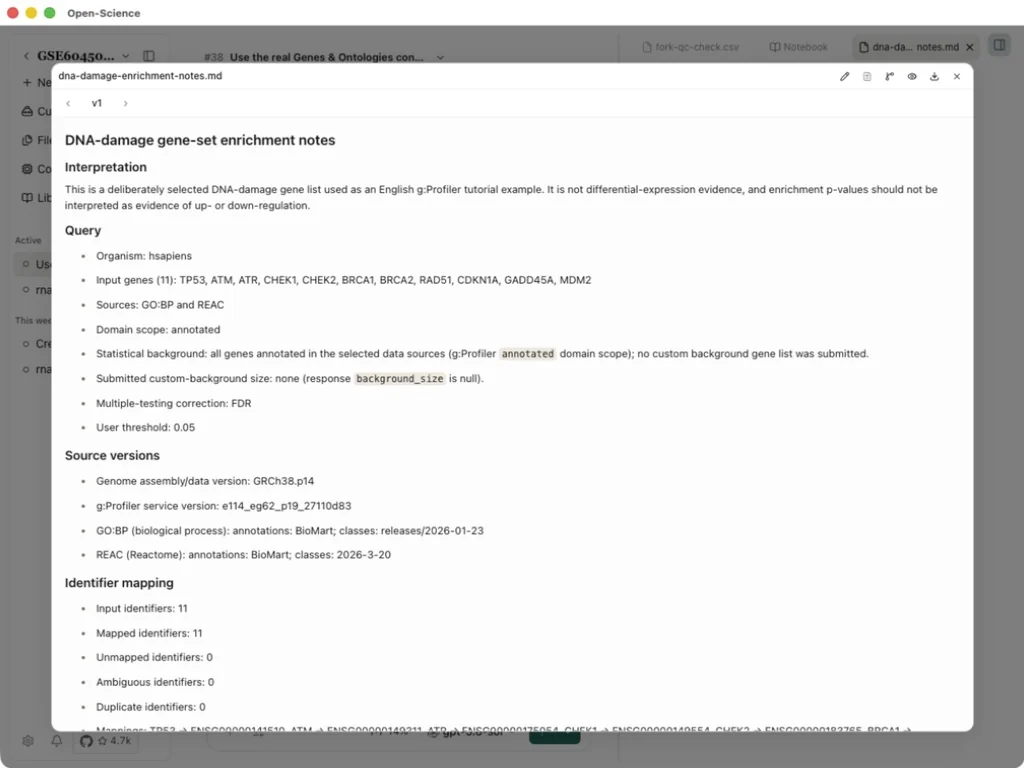
This v0.31.1 example uses 11 public gene symbols to demonstrate g:Profiler. They were chosen for their known biological roles, so enrichment is expected. They are not differential-expression results from the GSE60450 project or evidence of an unbiased discovery.
1. Define the gene list and analysis settings
- In Settings → Connectors, make Genes & Ontologies available to the agent. Open a session with a connected model and an available Notebook runtime.
- Specify the organism, gene identifiers, data sources and statistical background. For real experimental data, justify the background using genes that could have been selected by the experiment. This tutorial explicitly uses all annotated genes, not a custom measured-gene universe.
- Send the following prompt. Keep the source-version query and enrichment call in the same session and save their actual results.
Use Genes & Ontologies through Session Notebook for an English g:Profiler
tutorial. The deliberately selected gene list is TP53, ATM, ATR, CHEK1,
CHEK2, BRCA1, BRCA2, RAD51, CDKN1A, GADD45A, MDM2.
First call list_enrichment_sources with organism hsapiens.
Then call enrich_gene_set with these genes, organism hsapiens,
sources GO:BP and REAC, domain_scope annotated,
correction_method fdr, and user_threshold 0.05.
Save the full response as dna-damage-enrichment.json, all returned terms
as dna-damage-enrichment.csv, and query, source versions, mappings,
background and limitations as dna-damage-enrichment-notes.md.
Retain unmapped, ambiguous and duplicate identifiers. Treat mapped_genes
as the returned mapping object. Report errors instead of inventing results.
This is not differential-expression evidence or evidence of regulation direction.
2. Check identifiers and source versions
Open the generated notes and check the query and mapping counts. This run mapped 11/11 identifiers, with 0 unmapped, ambiguous or duplicate identifiers. It recorded GRCh38.p14, g:Profiler e114_eg62_p19_27110d83, GO classes 2026-01-23 and Reactome classes 2026-03-20. A later service version may return different terms.
3. Inspect the enrichment table
Open the CSV and compare it with the full JSON. This run returned 891 terms at FDR 0.05. The preview shows only its first 100 rows; that display limit is not the total result count. Retain source, native, corrected p_value, intersection_size, query_size and effective_domain_size when interpreting a term.
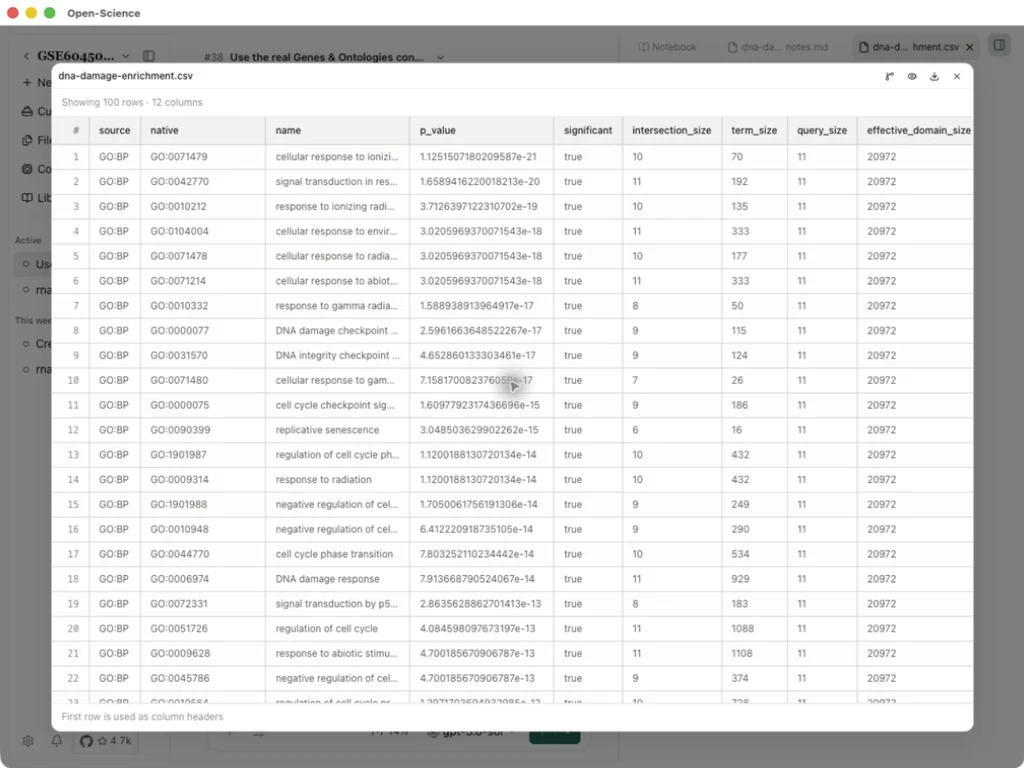
Analysis notes · All 891 result rows · Full response
background_size: null means no custom background list was submitted; it does not mean a statistical universe of zero genes. Use the per-term effective domain size. Enrichment does not establish causal involvement, differential expression, or up/down regulation. See operation parameters.