Network, proxies, and package mirrors
Open Settings → Network when a model, Notebook request or package download cannot reach its destination. This page separates connection status, Notebook allowed domains, a process proxy and package mirrors. A green connection check does not prove that every protected Notebook request will succeed.
Start with the failing operation: a provider request, Notebook network access and a package installer can use different routes. Keep its hostname and exact error available while changing these settings.
Read Network status first
The status combines network-link information and a package-registry probe. READY · Package registries are reachable indicates that probe succeeded. Checking, unreachable or offline states indicate that another check or connection repair is needed. Use Check again when available after changing the connection.
If Network reports Ready but a tool fails, expand that tool's error. The status probe checks its own destination; use the failed request's hostname and message to diagnose the affected route.
| Failure | Inspect next | Avoid this mistaken conclusion |
|---|---|---|
| Provider login fails | Provider authentication and the model connection check | Notebook domain settings will supply model credentials |
| One research hostname is denied | Configure domains and the exact hostname in the request | Adding a broad unrelated domain will fix it |
| A package host is already allowed but CONNECT fails | Installer log, proxy and DNS resolution | Another identical Allow click will resolve all network failures |
| Certificate verification fails | The configured CA bundle and the organization's trust requirements | Disabling certificate verification is necessary |
| Package index returns no matching distribution after connection errors | Earlier network messages and selected Python/platform | The package must not exist |
Configure Notebook domains
- Select Configure domains.
- Read whether Notebook network protection is active on this device.
- Expand the scientific-service groups to inspect their hostnames. Group switches control included destinations. The package-registry/source-code group is enabled and locked in this build.
- For an additional source, enter its exact hostname in Domain hostname, then select Add.
- Review the new draft row. Use Remove [hostname] to undo it.
- Select Save changes to persist the intended list.
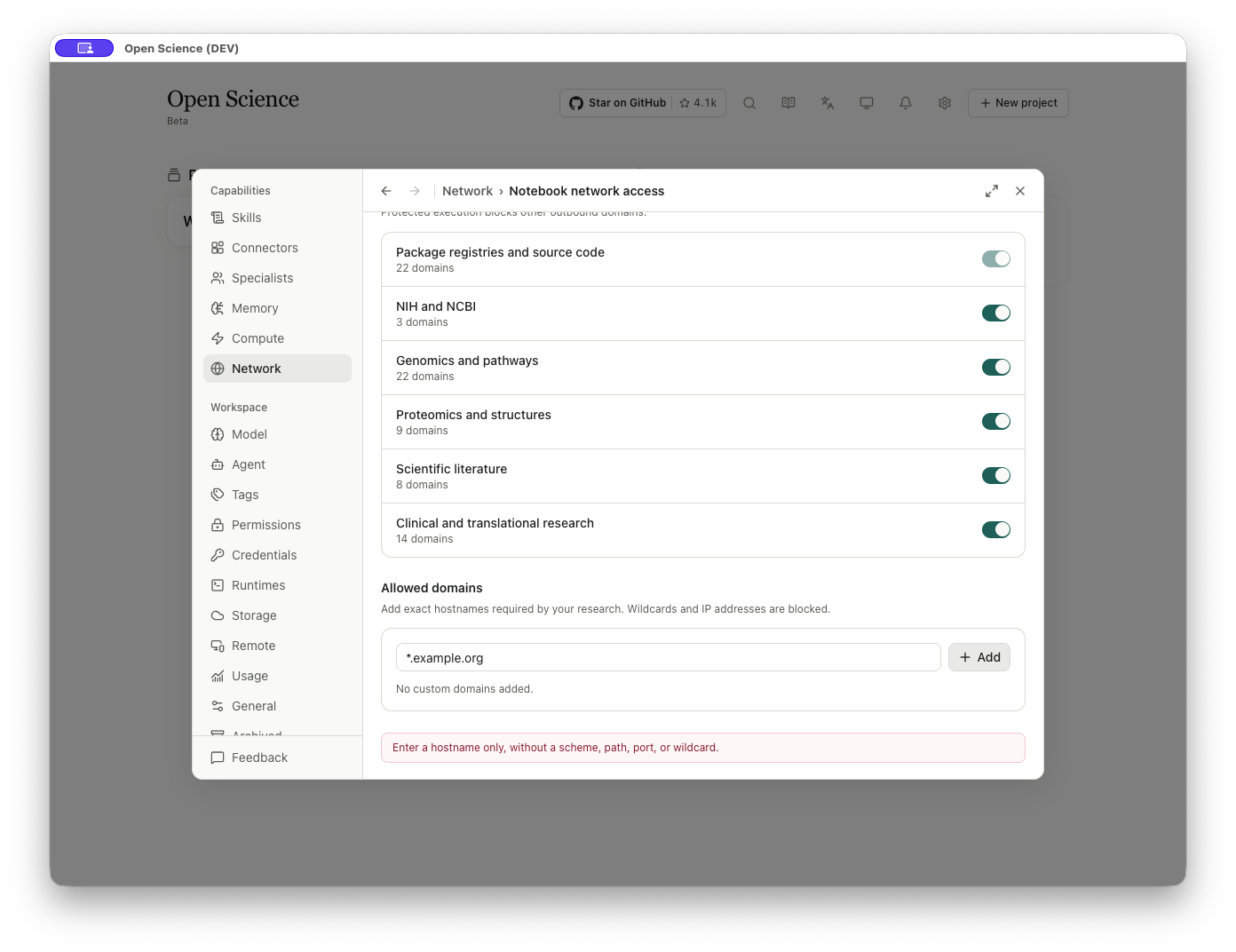
Enter a hostname such as data.example.org, with no scheme, path, port, wildcard or IP address. For Enter a hostname only, without a scheme, path, port, or wildcard., remove those parts and save the hostname.
A domain allowed by name can still fail another connection check. For example, pypi.org can be allowed but rejected as a non-public destination if it resolves to 198.18.*. This is distinct from an unapproved domain.
Choose a proxy mode
Select Configure proxy. Use a proxy address supplied by your own network configuration; the port in a screenshot is specific to that computer.
| Mode | Behavior | Required input |
|---|---|---|
| System | App requests follow the device proxy; agent processes inherit proxy environment from app startup | No explicit server field |
| Manual | Give new app requests and processes a fixed proxy | Proxy server URL |
| Direct | Connect without the configured/inherited proxy for new processes | No server field |
Manual mode accepts HTTP, HTTPS, SOCKS, SOCKS4 and SOCKS5 URLs. Embedded credentials in the URL are not supported. Bypass rules is an optional comma-separated list of hosts that should connect directly; localhost is always bypassed.
- Choose Manual.
- Fill Proxy server with the working proxy address used by your network.
- Add bypass rules only if the relevant destinations should connect directly.
- Select Save and wait for Proxy settings saved.
- Start a new request/process and test the original failing operation. Existing agent sessions, kernels and installers can keep their existing connections.
If Manual mode reports Enter a proxy server URL, enter a working proxy address or discard the draft with Done. Saving a valid address does not itself confirm that the proxy can carry the failing request.
When a domain resolves to a non-public address
If installation reports destination resolves to a non-public network address, inspect the detailed installer log even when the short error only says conda install failed or pip install failed.
deny network-outbound pypi.org:443
(destination resolves to a non-public network address)
- Check the affected hostname and its resolved address. Addresses such as
198.18.*are not public destinations. - Distinguish a domain-list decision from the destination check.
alreadyAlloweddoes not establish that the resolved address is acceptable. - Check public DNS resolution and the intended proxy route with the network owner, then retry the original small request. Keep domain protection enabled.
- Verify installation and import separately. A saved proxy, Ready interpreter or successful use of existing packages is insufficient.
If the same error persists, keep the hostname, resolved address and proxy mode with the installer log and follow Troubleshooting. A successful settings save is not a successful download.
Configure package mirrors and certificate trust
Select Configure or Edit under Package mirror.
| Field | Input and effect |
|---|---|
| Conda channel mirror | Mirror root used for Conda channel downloads |
| Python package index (pip) | A Python package index URL, typically ending in /simple |
| CA bundle path | Path to a complete PEM trust bundle including required public and corporate roots; blank uses public certificate authorities |
| View available mirrors | Open external mirror documentation |
| Save | Store the configuration for subsequent package operations |
| Cancel | Discard the draft |
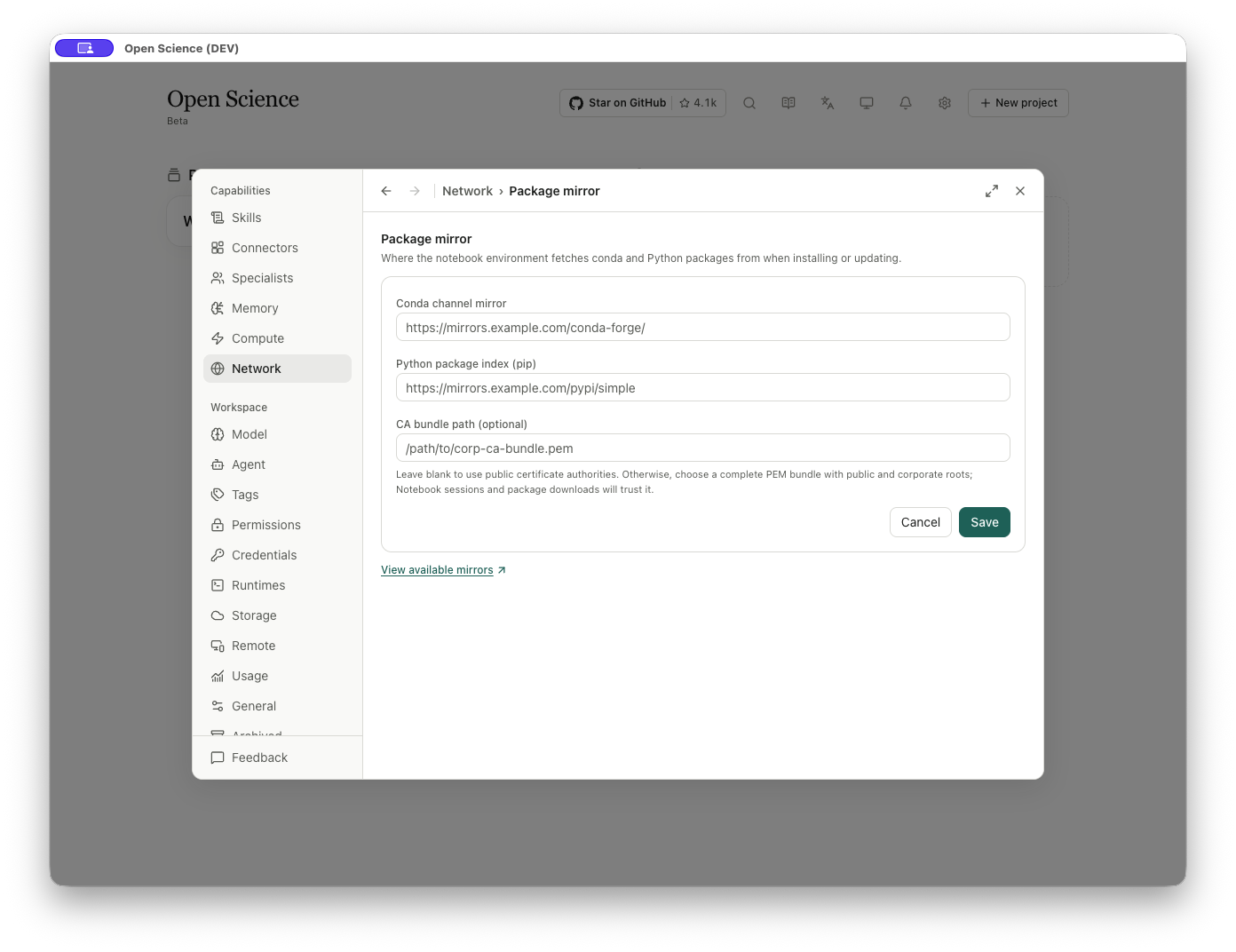
A package mirror changes the package source. Confirm the mirror's required root/index format, save, and retry a small package operation in the selected runtime. Model-provider proxy settings are separate.
Configured Conda, PyPI and CRAN mirror hostnames receive temporary access for the package-management operation. This does not add them to the permanent Notebook domain list or grant ordinary Notebook code the same access. Redirects to other hosts still follow the network approval flow.
Use a supported HTTP(S) mirror URL without embedded credentials, whitespace, localhost or a raw IP address. An accepted mirror setting does not fix an unavailable server or a hostname resolving to a reserved address. If installation fails, inspect that operation’s actual destination and error before retrying. Remote model endpoints have a separate HTTPS requirement.
Information to keep when a request fails
Record the app version, operation, runtime/environment, package or hostname, proxy mode and first useful error. Preserve the original installer output: the final “No matching distribution” line can conceal earlier connectivity failures. Exclude tokens and proxy credentials from shared diagnostics.
For a missing Python module after a successful connection, continue with runtime and package checks. Remote host setup is covered separately in Compute.
Network settings source, Notebook network boundary.
HTTP error lookup
For 400, 401, 403, 404, 429 or 5xx responses, use the HTTP troubleshooting table. Keep the responding service and its detailed message with the status code.
After changing proxy, mirror or Notebook domain settings, confirm the values persisted, then retry the original operation in the same runtime. Check both the download and package import; a successful settings save alone does not resolve an installation error.