Opening and previewing files
Open a saved result to inspect its selected version. This page covers shared viewing controls and ordinary document formats. Use Tables for data interpretation and Scientific viewers for sequence and structure controls.
Open, enlarge and return
A generated-file card opens its preview. Open … in split view beside the session keeps the conversation visible. Select another tab to switch files, Open full screen preview of … to enlarge one, and Close preview of … to close that surface. Collapse preview panel hides the panel without deleting its open files. A full-screen preview and a full-screen Files library are different views.
| Header control | Meaning |
|---|---|
| Filename and version | Confirm the selected result before downloading or citing it |
| Download | Save a copy of that result |
| File actions → Provenance | Inspect evidence attached to a managed artifact version |
| View in context | Return to the session that produced the artifact |
| Previous / Next file version | Navigate immutable saved revisions when available |
| Edit / Compare | Available only for supported managed content; see Files |
| Close | Dismiss the view; this is not Delete |
The closing behavior above applies to file previews. A Side Chat tab has a separate confirmation because closing it stops and deletes that side discussion.
To save a reading location for yourself, select text or a PDF region and choose For me; see Reading bookmarks.
Read files by format
Read a result table
Worked example Read the RNA-seq QC table, figure and report
Open rnaseq-sample-qc.csv. In this example, it shows 12 rows · 6 columns and uses the first row as headers. Horizontal scrolling exposes long source-column names and the metrics to their right. The table's row numbers are display positions, not gene or sample IDs.
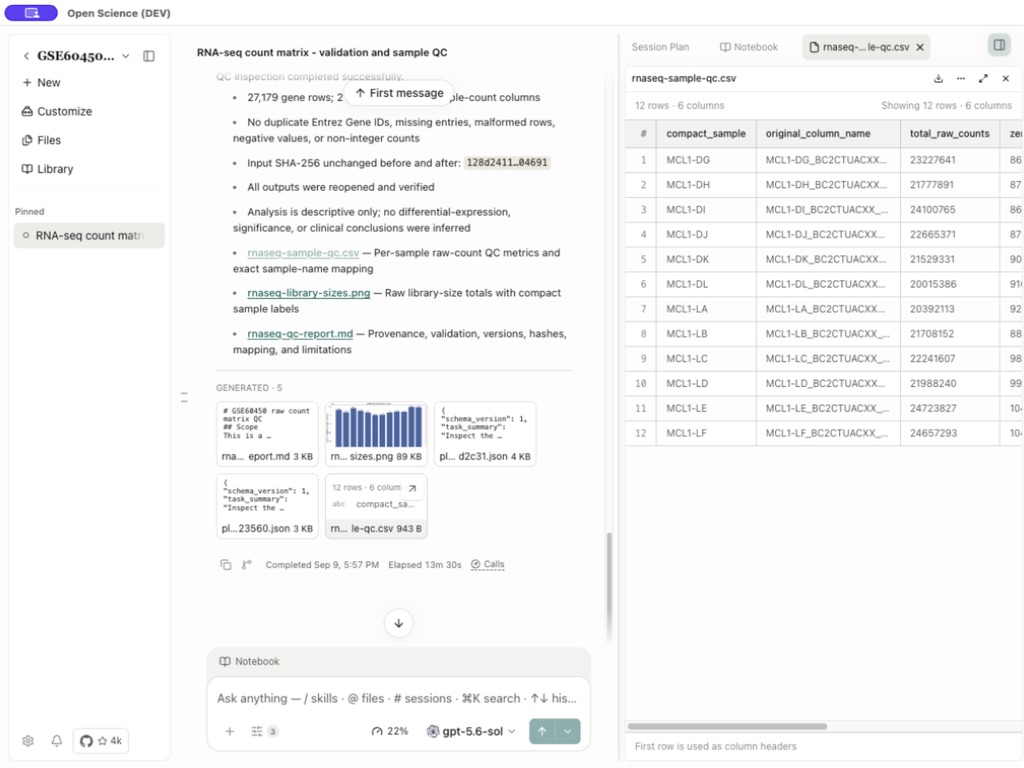
Check that column labels and full identifiers are readable. Field definitions and checks against the shared baseline are in Tables and datasets.
The source .txt is a tab-separated matrix; a text viewer may display it as text rather than the CSV grid. Do not rename a file's extension and assume its delimiter or scientific meaning changed. Very large previews can be bounded; read any displayed row/column limit before treating the visible subset as the full dataset. Format limits are in Reference.
Inspect the figure
Open rnaseq-library-sizes.png. Use Zoom in, Zoom out and Reset zoom; open full screen when axis labels are too small. Zoom changes only the view. It does not resample the source matrix or update a statistical result.
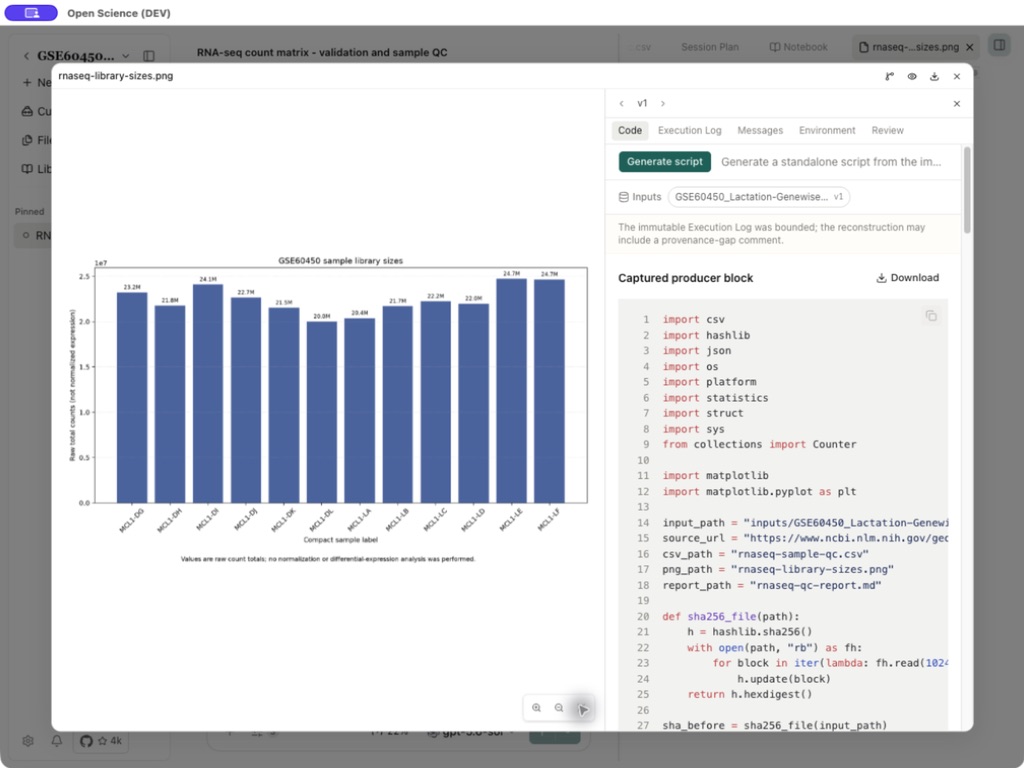
Read the raw-count axis, all twelve sample labels and their mapping in the CSV/report. Different bar heights alone do not establish differential expression. The example is a descriptive pre-analysis check, with no normalization or hypothesis testing.
Read methods and provenance together
Markdown renders headings, lists, code and links. Read the report's checksum and method before accepting the plotted result. An authored link opens its destination through the applicable source-preview or external-browser action; inspect the full hostname before treating it as evidence. A failed or blocked source preview is not confirmation that its contents were read.
Use Provenance to inspect the selected artifact's code, execution log, messages, environment and review. Read any partial, bounded or No review for this version label using Notebook and execution evidence.
Read Office files and multi-page figures
Worked example Inspect Office and TIFF reading copies of the QC results
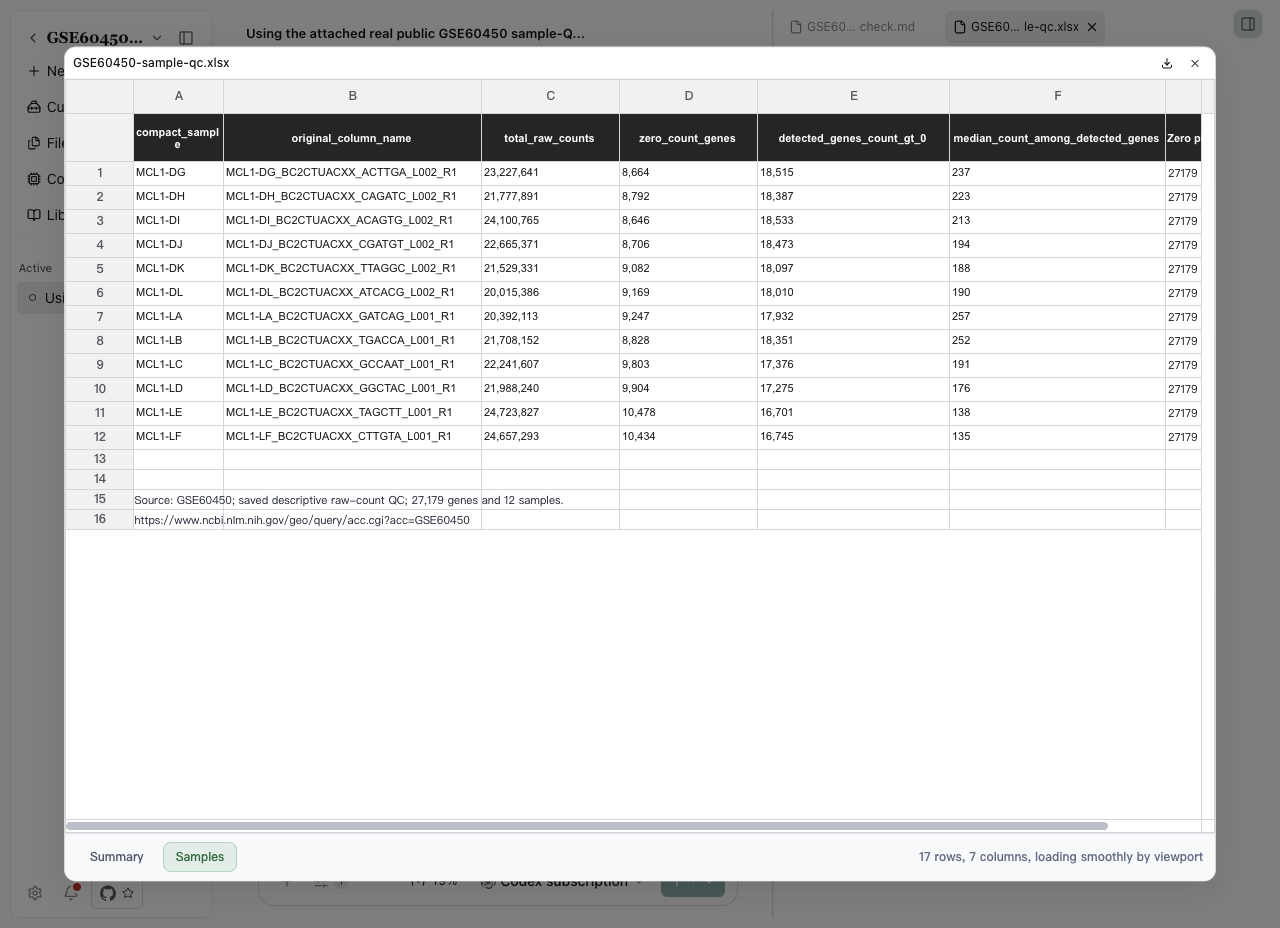
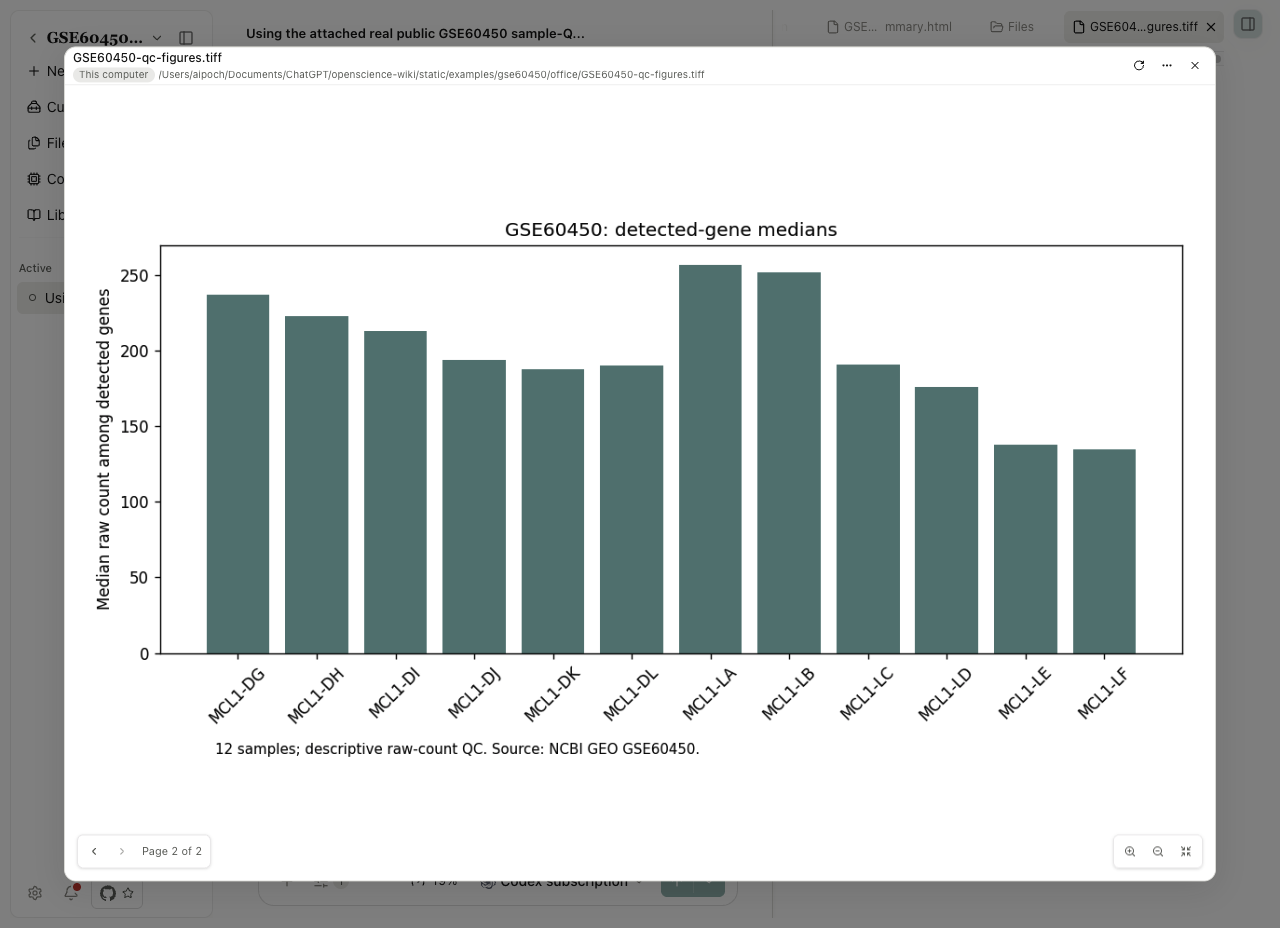
The Word report, Excel workbook, PowerPoint slides and two-page TIFF present the same saved GSE60450 QC results. These are reading copies, not new analyses.
| Format | Steps and what to check |
|---|---|
| DOCX | Attach and open the report. Scroll through both pages; check the first sample row and the methods/interpretation text. Full-screen preview gives long lines more space. There is no Word editing ribbon. |
| XLSX | Open the workbook, then choose Summary or Samples at the bottom. Scroll horizontally for the last column. Samples contains 12 data rows plus its header, spacing and source notes; the viewer reports 17 used rows, not 17 biological samples. Values are a preview of the saved workbook, not evidence of a fresh calculation. |
| PPTX | Open the slides and scroll vertically from the QC summary to Methods and interpretation. Both slides rendered in the local example. This reading surface is not a presentation editor or slideshow controller. |
| TIFF | Open the figure and use Next page / Previous page. The two pages show raw library sizes and detected-gene medians. Zoom in / Zoom out / Reset zoom changes the view; check Page 1 of 2 or Page 2 of 2 before interpreting the figure. |
| JSON | Open the summary to inspect source text, identifiers and values. It displays as code rather than an expandable object tree. |
| HTML | Open the reading table. Source shows the HTML; Render restores the formatted document. Neither mode reruns the QC. |
If Preview unavailable → Open this Office file in your default app to view it. appears, use Open for a local file, or Download for a managed upload, then open it in a compatible application. This fallback keeps the original file available when the built-in preview cannot display it.
Other supported viewers
The following table lists preview modes and controls for supported file types.
| Family | What to inspect | Controls and boundaries |
|---|---|---|
| Page number, readable text, source PDF | Thumbnails, outline, document search, page navigation, zoom and selectable regions; scanned pages may lack searchable text | |
| Code / plain text | Complete relevant block and language | Line numbers, syntax display, copy/download; oversized content can be limited |
| JSON / HTML | Structure or rendered document | Rendering is not permission to execute code with application privileges |
| Images / TIFF | Resolution and selected image | Image zoom/pan; TIFF has a dedicated rendering path |
| Office files | Whether the managed renderer succeeds | Download/open externally if DOCX/XLSX/PPTX preview is unavailable; preview is not full Office editing |
| Biological sequences | Sequence identity and extent | Sequence-oriented view for supported FASTA inputs |
| Molecular structures | Parsed model and chosen representation | Rotate, zoom, pan and supported Cartoon/Stick/Sphere/Surface/Line representations; missing structural data can disable a representation |
| Unknown or unsupported file | Name, size and fallback message | Download for a suitable external viewer; do not infer valid content from the extension |
For PDF context, link only the papers relevant to the current task and unlink them when the next task should not use them. The app supports up to three linked PDFs per session. A literature record without an attached PDF provides metadata, not proof that full text was read; see Library.
Diagram source and format-specific controls
For a rendered Mermaid diagram in a conversation, select View source in its action bar to read the underlying diagram text; View diagram returns to the rendering. The toggle becomes available after rendering and is disabled while an error replaces the diagram. It changes the view, not the analysis or source file.
Example Switch between a Mermaid diagram and its source
In a new conversation, ask: Show a Mermaid flowchart with three steps: Attach a file → Inspect the preview → Save a report. Do not include file links. Once rendered, hover over the diagram, select View source, and confirm the three nodes. Select View diagram to return; use View fullscreen if labels are too small.
The diagram displays the requested steps. To inspect a saved file, open its actual file card; a diagram node alone is not an artifact reference.
| Format | What to check |
|---|---|
| Single-page PDF | No multi-page Reading entry; use the PDF's ordinary preview controls |
| CSV | Inspect the displayed range; a bounded preview must not be treated as the complete input/export |
| Office workbook | Check the selected visible worksheet and renderer error; use the original file for unsupported editing |
| TIFF | Check the selected page and rendering result before interpreting pixel/sample values |
| JSON | Consult the preserved source text when formatting matters |
| Markdown tables | Focus the table actions to use copy/download/full-screen controls with the keyboard |
Implementation references: Mermaid controls, PDF condition, CSV, Office, TIFF.
Extract PDF figures and tables
Use this when you need a figure or a reusable table from a literature PDF. Add and inspect the PDF in Library first; bibliographic metadata alone is not an extraction input.
- Open the PDF preview and select Figures and tables beside Original PDF.
- On first use, choose Download and continue to install the required model resources. Wait for installation and integrity checks. When resources are ready, use Analyze PDF.
- Follow the page progress. After completion, select a candidate and use Show in PDF to compare it with the source page, caption and surrounding text.
- For a figure, open its image preview and use Copy image or Download image. For a table, select Table, choose TSV, HTML or Markdown, then use the copy/download action. Choose Image when you need to inspect the source crop.
- Reopen the exported file. Check row/column alignment, merged headers, units, footnotes and cross-page content before using it in an analysis or report.
Extraction runs locally after the model resources are downloaded. Reopening the same PDF can reuse cached results; Analyze again reruns extraction when needed. Cancel through the progress control if you need to stop. If analysis is incomplete, inspect the failed-page notice rather than treating the visible candidates as the complete document.
Unplaced table text and Table notes preserve content that needs review. If structured cells are unavailable, use the source crop and original PDF; do not infer missing cells. Scanned and rotated pages are not supported by this extraction workflow. A PDF can remain readable even when extraction is unavailable.
Ask the agent about an extracted figure or table
- Open the intended PDF, use Read with agent to link it to the current session, and complete Figures and tables analysis for the relevant pages. Before sending your question, confirm that the PDF remains in the Composer’s reading context. A Library record by itself is not a linked PDF, and linking alone does not run this analysis.
- Ask about a specific figure, table or algorithm. Include its label or page and the question you need answered.
- Inspect the tool activity: list_pdf_elements finds the available extracted elements; read_pdf_element reads the selected evidence. Ask for the source page and any missing or uncertain content in the answer.
- Compare the answer with the original figure or table, including headers, units and notes. If extraction is absent or incomplete, analyze the missing pages and retry; a caption alone cannot establish a trend or an exact table value.
Example Request table evidence from a linked paper
Read Table 1 from the linked PDF's extracted elements. Report the physical PDF page, column headings and values relevant to my question. Preserve units and footnotes, and identify any missing cells or incomplete extraction.
These tools read existing extraction results; they do not start PDF analysis. Table output may arrive in several batches, and figure/algorithm evidence can be delivered as an image. Check that the selected model supports the required image input; a delivered image alone does not prove it was interpreted correctly.
Load remote media deliberately
Images, audio and video linked from a model response wait for you to activate loading. Read the destination hostnames shown by the control before proceeding. Approval applies to that displayed element and its URLs, not every future response or the whole domain. Closing the preview does not undo a request already sent.
Mermaid diagrams containing remote images can be blocked before loading; request an ordinary diagram without embedded images when needed. For images sent to a model, Open-Science removes ancillary metadata from the model-input copy while preserving the original file. This does not remove sensitive content visibly present in the image.
Verify the downloaded file
Open the intended preview, choose Download, confirm the filename and location in the system save dialog, then save. Open the downloaded copy and check its content. Download saves the original file; switching TIFF page or Excel sheet does not restrict the download to that page or sheet.
When a preview fails
Confirm the file saved successfully, then check the exact version and format. Try Download to distinguish a viewer limitation from an unavailable file. For a local file changed outside the app, use Reload where offered. Do not overwrite the input to repair a rendering issue. Report the filename, type, size, app version and displayed error; exclude private file contents unless they are needed for diagnosis.